Mirrai Careers
Chronological Resume Format: When to Use It and How (2026)
75% of executives prefer chronological resumes. Functional format is now listed as obsolete. Here is the format most recruiters expect, and when to use something else.

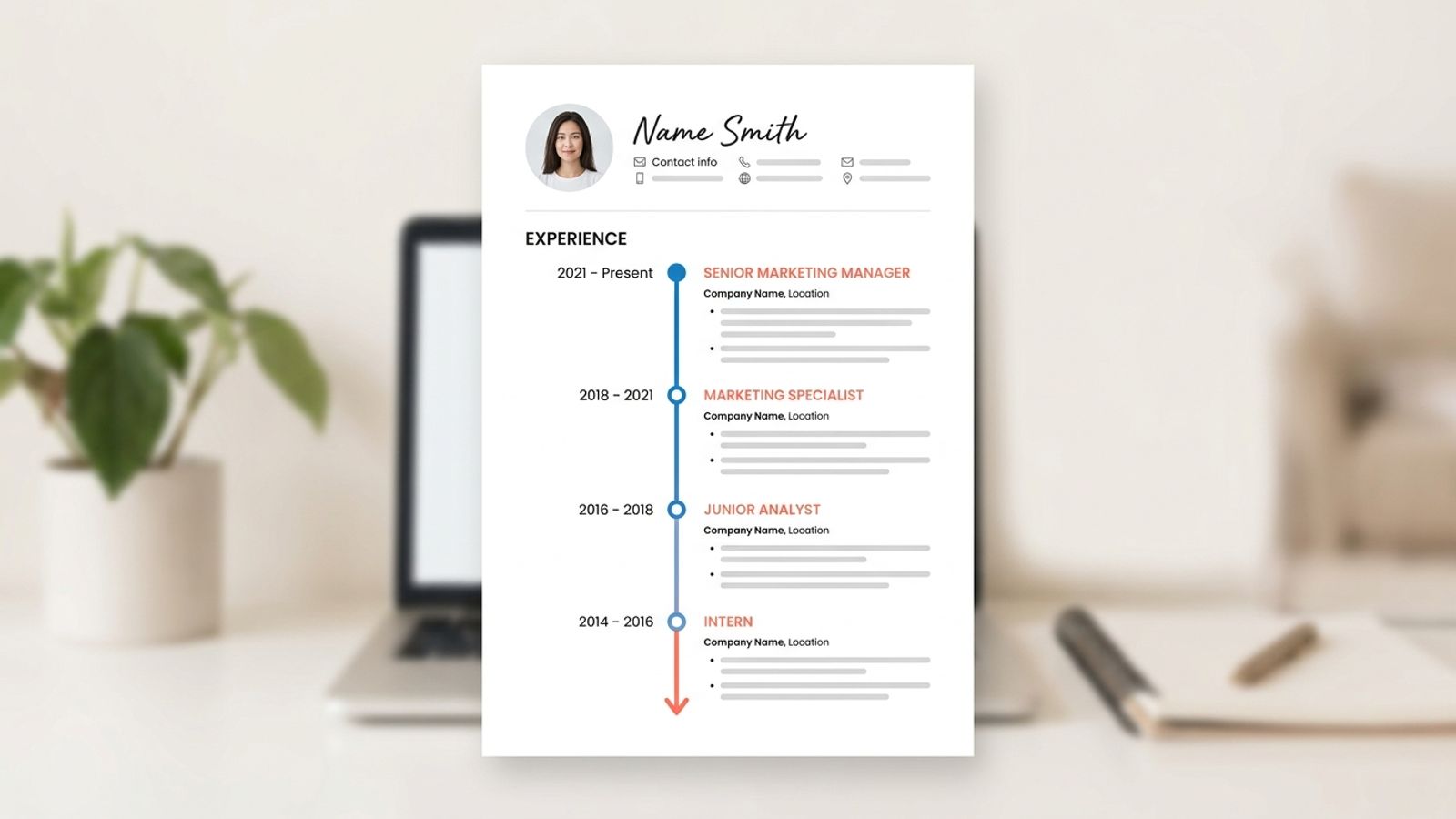
75% of senior executives prefer chronological resumes over any other format (Accountemps, survey of 150 execs at top 1,000 companies). 66% of organizations prefer it over functional (SHRM). ATS systems parse it with 93-97% accuracy because the structure matches what they expect: job titles, companies, dates, achievements, top to bottom.
The reverse-chronological format (most recent job first) is the default for a reason. If you have a steady work history in one field, this is the format that gets your resume read. If you don't, there are better options than pretending you do.
Every other format is a bet that the recruiter will spend extra time figuring out your timeline. Spoiler: they will not.
Mirrai Careers
Match your resume to any job in seconds
Upload your resume, paste a job description, see your match score.
Try FreeFree month of Pro with code LAUNCH
What Is a Chronological Resume
A chronological resume lists your work experience in reverse order, starting with your most recent or current position. Each role includes job title, company name, dates, and 3-5 bullet points describing what you achieved (not what you were responsible for).
The section order:
- Contact information (name, phone, email, LinkedIn, location)
- Professional summary (3-4 lines: what you do, your biggest achievement, what you bring)
- Work experience (reverse chronological, most recent first)
- Education (highest degree first)
- Skills (hard skills first, organized by category)
- Optional: certifications, volunteer work, projects, languages
88% of hiring managers say work experience is the most important resume section (Enhancv). The chronological format puts it right after the summary. When someone is spending 7.4 seconds on your resume, where your experience sits on the page is everything.
Chronological vs Functional vs Hybrid
| Chronological | Functional | Hybrid | |
|---|---|---|---|
| Recruiter preference | 66-75% | ~17% | 43% (mid-career) |
| ATS compatibility | Excellent (93-97% parse rate) | Poor (breaks expected structure) | Good |
| Shows career progression | Yes, clearly | No | Yes |
| Emphasizes skills | Through work context | Skills listed without job context | Skills section + work context |
| Hides employment gaps | No | Attempts to (but raises suspicion) | Partially |
| Best for career changers | No | In theory, but risky | Yes |
| Recruiter suspicion | None | High | Low |
| 2026 status | Standard, universally accepted | Listed as obsolete | Growing alternative |
The functional resume is now listed as one of three obsolete resume formats for 2026 (The Interview Guys). Recruiters receiving 300-500 resumes per week will not spend time mapping your skills to your timeline. They will assume you are hiding something and move on.
“As someone who used to screen resumes as admin... functional resumes are the worst. Recruiters wanted to know what you did at each role, and when.”
How to Structure a Chronological Resume
Each work experience entry follows this format:
| Element | Example |
|---|---|
| Job title | Senior Marketing Manager |
| Company + location | Acme Corp, Chicago, IL |
| Dates | Jan 2022 - Present |
| Bullets (3-5) | Achievement-focused, starting with action verbs, including metrics |
Bullets should follow the formula: [Action verb] + [what you did] + [measurable result]. "Managed social media" becomes "Grew Instagram following from 2,400 to 18,000 in 12 months through data-driven content strategy."
For older roles (10+ years ago), reduce to 1-2 bullets or combine into an "Earlier Career" line: "Earlier: Marketing Coordinator at XYZ Corp (2012-2015), Marketing Assistant at ABC Inc (2010-2012)."
Need help writing achievement-focused bullets? See our action words for resume guide with 200+ power verbs and before/after examples.
Who Should Use a Chronological Resume
Use this format if:
- You have 2+ years of consistent work experience in your field
- Your career shows clear progression (promotions, increasing scope)
- You have minimal gaps between positions
- You are applying to traditional or corporate employers
- You are staying in the same industry
This covers 70-80% of job seekers. If your career moves in a straight line, use this format. Recruiters will get it in seconds. That is the entire point.
Who Should NOT Use a Chronological Resume
The chronological format works against you when your timeline doesn't tell the story you want:
- Career changers: your most recent experience is in a different field than your target role. Chronological highlights the mismatch.
- Employment gaps: dates are front and center. A 2-year gap between 2022 and 2024 is immediately visible.
- Recent graduates with limited work history: the experience section looks thin.
- Frequent job changes: 4 jobs in 3 years reads as instability, even if each move was strategic.
- Re-entering the workforce after extended absence (caregiving, health, travel).
In these cases, use the hybrid/combination format. It leads with a skills section that matches the job description, then follows with chronological work history. Skill emphasis without the suspicion of a functional resume.
What not to do: switch to a functional format. "The vast majority of job seekers who use this format are doing so to hide something" (ResumeSpice). Hiring managers have literally asked candidates to rewrite functional resumes into chronological ones because they couldn't evaluate them otherwise.
ATS and the Chronological Format
97.8% of Fortune 500 companies use ATS (CoverSentry). ATS parsers are built to read resumes in a predictable structure: header, summary, experience with dates, education, skills. The chronological format matches this expectation almost perfectly.
Parsing accuracy by format:
| Format element | Single-column chronological | Two-column | Functional |
|---|---|---|---|
| Overall parse rate | 93% | 86% | Poor (skills detached from context) |
| Skills extraction | 65% | 46% | High extraction, low context |
| Job title + company matching | Excellent | Good | Broken (no timeline context) |
The "75% of resumes are auto-rejected by ATS" stat is a myth. It originated from Preptel, a company that closed in 2013, with no disclosed methodology. 92% of recruiters confirm their ATS does not auto-reject based on formatting (Enhancv, 2025 study). What actually happens: poorly parsed resumes become unsearchable in the database. Nobody rejected you. Nobody found you.
Check if your resume parses correctly. See your ATS match score in 30 seconds.
Before you leave
See how your resume stacks up
Paste any job description and get your match score in 30 seconds.
Try FreeFree month of Pro with code LAUNCH
FAQ
Is reverse-chronological the same as chronological?
How far back should a chronological resume go?
Can I use chronological format with employment gaps?
Should entry-level candidates use chronological format?
Does ATS prefer chronological resumes?
Build a chronological resume that passes ATS automatically. Try Mirrai's free Resume Builder.