Mirrai Careers
Resume vs CV: What's the Difference and When to Use Each (2026)
73% of job seekers don't know whether to send a resume or CV. The answer depends on where you're applying, not what sounds fancier.

Updated July 2026
Added a scannable "9 Key Differences" section, fresh 2026 ATS data, and cross-links to related resume guides. Fixed the search title to match how people actually look this up.
73% of job seekers don't know whether to submit a resume or a CV (Scale.jobs, 2025). Some send a 10-page academic CV to a startup. Others cram their entire career onto one page for a European employer that expects two. Both get rejected, confused why.
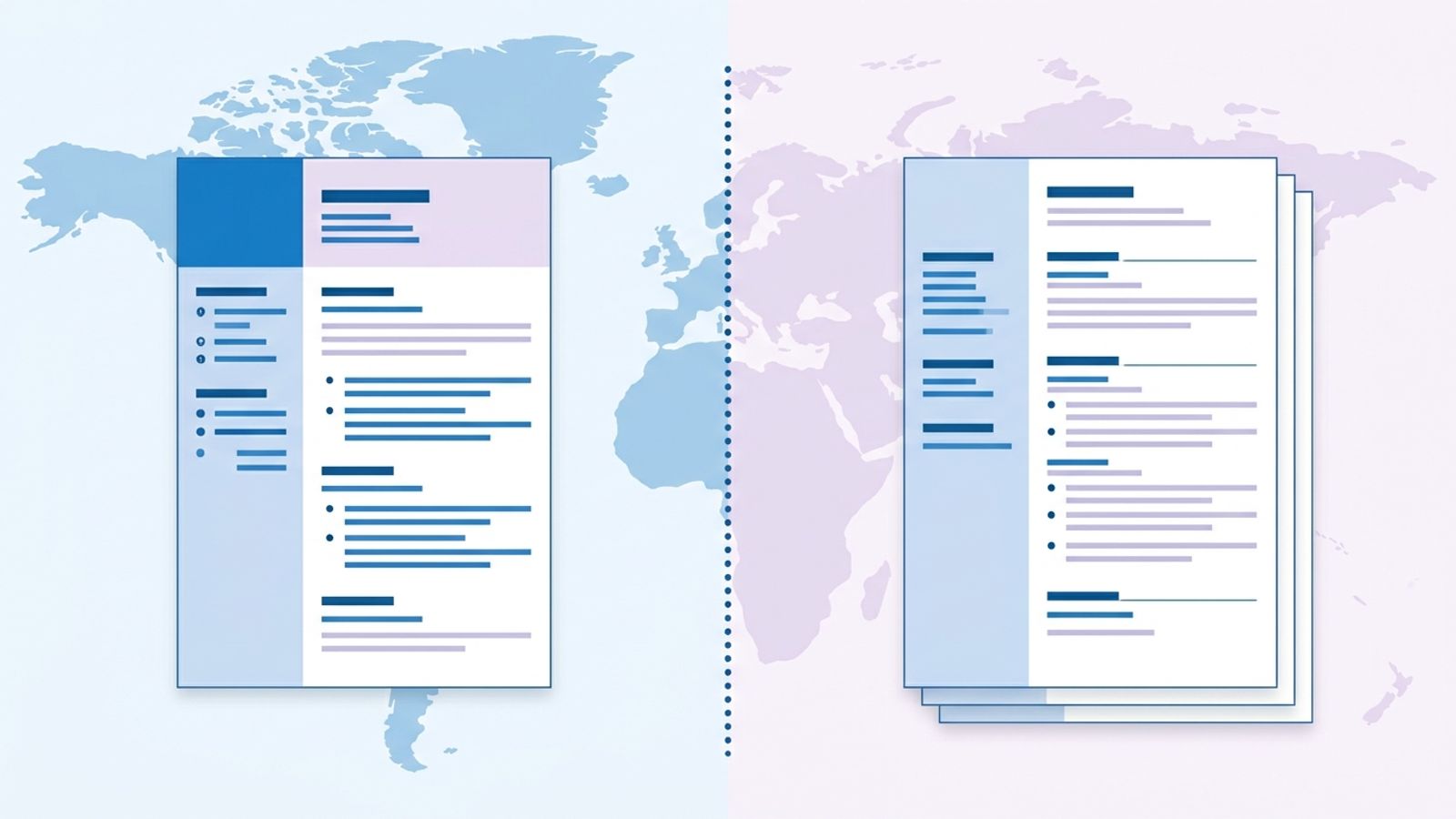
The confusion exists because "CV" means completely different things depending on where you are. In the US, it's a lengthy academic document. In the UK, it's what Americans call a resume. In Japan, you need two separate documents. In India, there's a third format called biodata.
Nobody should need a guide for this. But here we are, because the world decided one word should mean two different things.
Mirrai Careers
Match your resume to any job in seconds
Upload your resume, paste a job description, see your match score.
Try FreeFree month of Pro with code LAUNCH
Resume vs CV: The Short Answer
| Resume | CV (Academic, US/Canada) | CV (International) | |
|---|---|---|---|
| What is it | 1-2 page summary tailored to a specific job | Comprehensive academic/research history | Same as a resume (different name) |
| Length | 1-2 pages | 2-20+ pages (grows over career) | 1-2 pages |
| Where used | US, Canada (industry jobs) | US, Canada (academia, medicine, research) | UK, Europe, Australia, Asia, Middle East, Africa |
| Tailored? | Yes, for each application | No, comprehensive | Yes, for each application |
| Photo? | Never (US/Canada) | Never (US/Canada) | Depends on country (see below) |
If the job is in the US and isn't academic, send a resume. If the job is outside North America, send what they call a "CV" (which is a resume with a different name). If the job is academic anywhere, send an academic CV.
That's 90% of cases covered. The details below matter when you're applying across borders.
What Is a CV?
"Curriculum Vitae" is Latin for "course of life." The term means two completely different things depending on which side of the Atlantic you're on.
In the US and Canada: A CV is a multi-page document listing your entire academic and professional history. Publications, research projects, grants, teaching experience, conference presentations, awards. All of it. It starts at 2-3 pages for a PhD student and grows throughout a career. A senior professor's CV can run 20+ pages. It is never tailored per application because the whole point is to be comprehensive.
Everywhere else: CV just means "that document you send when applying for a job." It's 1-2 pages, tailored to the position, and functionally identical to what Americans call a resume. When a UK employer asks for your CV, they want a concise career summary, not your publication list.
This dual meaning is the root of all confusion. An American academic sending a 2-page resume to a research fellowship is underqualified on paper. A British professional sending a 1-page CV to a US recruiter is doing exactly what was asked.
What Is a Resume?
A resume (from French "résumé," meaning summary) is a 1-2 page argument for why you're the right person for this particular role. It's an argument, not a biography. Include only what matches the job you're applying for.
Standard sections: contact info, summary, work experience, education, skills. Optional: certifications, projects, volunteer work. Average length: 489 words across 1.6 pages (Standout-CV analysis).
Recruiters spend 6-8 seconds on first review (Forbes). 63% prefer resumes customized to the specific position (Glassdoor). 54% of candidates send the same generic document everywhere and then wonder why they don't hear back.
Resume vs CV by Country
This is the table nobody else has. Bookmark it.
| Country | They Call It | Length | Photo? | Special Notes |
|---|---|---|---|---|
| USA | Resume (industry); CV (academic only) | 1-2 pages | Never | Federal jobs: strict 2-page limit since Sept 2025. No DOB, age, or marital status. |
| Canada | Resume; CV (academic) | 1-2 pages | Never | Similar to US. British English spelling. YYYY-MM-DD dates. |
| UK | CV (always) | 1-2 pages | No | "CV" here means what Americans call a resume. A4 paper. |
| Germany | Lebenslauf | 1-2 pages | Strongly expected | Professional headshot top-right. Include birthdate and nationality. Attach certificates (Zeugnisse). |
| France | CV | 1-2 pages | Common | Cover letter (lettre de motivation) usually mandatory. Include nationality, DOB. |
| Spain | CV | Max 2 pages | Expected | Include DOB, nationality, full address. Passport-style photo. |
| Italy | CV | 2-3 pages | Expected | Must include GDPR data processing consent. Include DOB, nationality. |
| Netherlands | CV | 1-2 pages | Optional | Concise and factual. Dutch directness applies to resumes too. |
| Sweden / Nordics | CV | 1 page preferred | No | Minimalist layout. Work experience before education. |
| Australia | Resume or CV (interchangeable) | 2-3 pages | No | Longer than US norms. Grads: 1-2, Mid: 2-3, Senior: 3-5 pages. |
| New Zealand | CV or Resume | 1-3 pages | No | No age, DOB, marital status, nationality, or photo. PDF format. |
| Japan | Rirekisho + Shokumu Keirekisho | Two documents required | Yes (on rirekisho) | Unique system: rirekisho = standardized facts (1 page); shokumu keirekisho = detailed experience (1-3 pages). |
| South Korea | Iryeokseo + Gyeongnyeok Gisulseo | 1-2 pages | Yes | Education weighted heavily. Minimalist design. Korean for local companies. |
| China | CV / 简历 (Jiǎnlì) | 1-2 pages | Yes | Include gender, DOB, marital status. Humble tone (avoid strong self-promotion). |
| India | Resume (corporate); Biodata (government) | 1-2 pages | Common | "Biodata" is a third format: includes DOB, religion, marital status, father's name. |
| UAE / Gulf States | CV | 2-3 pages | Common | Must include nationality, visa status, marital status, DOB. |
| South Africa | CV or Resume | 1-2 pages | No | Accomplishment-focused. Skip personal details. |
| Brazil / Latin America | CV / Currículo | 2-3 pages | Varies | Include DOB, marital status. Bilingual CV recommended. |
| Singapore | Resume or CV | 1-3 pages | Common | Include nationality and work pass status. MNCs heavily use ATS. |
| EU (Europass) | Europass CV | 2-3 pages | Optional | Standardized EU template. Available in 31 languages. Declining in popularity. |
Sources: TopResume, VisualCV International Guides, CareerAddict, Modern Diplomacy.
The pattern: North America avoids personal info, Asia and Middle East expect it, Europe is somewhere in between and varies by country. Always check local norms before applying internationally.
If this table seems absurd, that's because it is. There is no good reason for "CV" to mean opposite things on different continents. But nobody asked us to design the system.
9 Key Differences Between a Resume and a CV
Here are the nine differences that actually matter, from what each document is for down to what an ATS does with it.
- Purpose. A resume sells you for one specific job. A CV documents your whole academic and professional record. One is a pitch, the other is an archive.
- Length. A resume stays one to two pages. A CV has no page limit and grows with your career, from three to five pages for a new PhD to eight or more for a tenured professor. Full breakdown in how long a resume should be.
- Tailoring. You rewrite a resume for every posting. A CV stays mostly fixed, because it is a complete record rather than a targeted argument. Resumes, though, still need tailoring to each job description.
- Content. A resume cuts anything that doesn't serve the target role. A CV adds publications, conference talks, grants, teaching, and your full education history.
- Region. In the US and Canada, "resume" is the default and "CV" means the academic version. In the UK, Ireland, and most of Europe, "CV" is simply what Americans call a resume.
- Photo and personal details. US and UK documents leave off photos, age, and marital status. In much of Asia and parts of Europe a photo is still expected, like Germany's Lebenslauf or Japan's rirekisho.
- Format. A resume can use columns, color, and design. An academic CV stays plain and chronological, because search committees want completeness, not styling.
- ATS handling. Both run through the same applicant tracking systems, and an ATS was screening at 97.8% of Fortune 500 companies in 2025 (Jobscan). Fancy CV formatting breaks a parser just as fast as a fancy resume does, so keep it ATS-readable.
- What to send. When a US posting says "CV" but asks for one to two pages, they mean a resume. When it asks for publications, they mean an actual CV. Read the ask, not the label.
When to Use a CV Instead of a Resume
Send an academic CV when applying for professor, researcher, or lecturer positions anywhere. Also for grant and fellowship applications, PhD programs, US medical positions, and any role that asks for publications or research experience.
Academic CV standard sections: contact info, education (listed first, not experience), publications (peer-reviewed and other), presentations, awards, grants with dollar amounts, teaching experience, research experience, professional affiliations, languages, references (named, not "available upon request").
Length by career stage: grad student 2-3 pages, postdoc 3-5, mid-career professor 5-10, senior researcher 10-20+. No upper limit. It grows your entire career.
Send a federal resume when applying for US government jobs via USAJOBS. Since September 27, 2025 (OPM Merit Hiring Plan, Executive Order 14170): strict 2-page limit for GS-5 and above. Must include hours worked per week, series/grade for federal positions, month/year dates. Exceeding 2 pages makes you ineligible. USAJOBS rejects the upload. Not a soft guideline. A hard cutoff.
This is a big change. Federal resumes used to run 4-5 pages. If you're applying to government roles and still using your old 5-pager, update it before you submit.
Can ATS Handle Both?
In other words: stop worrying about the label. Worry about the formatting.
ATS doesn't know or care whether you labeled your document "resume" or "CV." It parses both exactly the same way (Pitt Career Central). The parser reads text, extracts keywords, and scores you against the job description.
What ATS does care about:
- Standard section headings (Education, Experience, Skills, not creative alternatives)
- Simple formatting (no images, complex tables, or multi-column layouts)
- Keywords matching the job description (66% of ATS can't understand synonyms)
- File format (PDF or .docx, created from text, not scanned/image PDFs)
- Text not hidden in headers or footers (ATS skips those)
97.8% of Fortune 500 companies use ATS (Jobscan 2025). The document label does not affect parsing. The formatting and keyword match do.
Whether you call it a resume, CV, Lebenslauf, or 履歴書, if ATS can't parse it, nobody will read it.
Not sure if your resume passes ATS? Check your match score in 30 seconds. Paste any job description and see exactly what's missing.
Before you leave
See how your resume stacks up
Paste any job description and get your match score in 30 seconds.
Try FreeFree month of Pro with code LAUNCH
FAQ
The job posting says "CV" but I'm in the US. What do I send?
I'm transitioning from academia to industry. How do I convert my CV?
Should I include a photo on my resume?
Is a 1-page resume always better?
Does ATS reject CVs?
Ready to build a resume that works in any format? Try Mirrai's free AI Resume Builder. It handles ATS formatting automatically.