Mirrai Careers
ATS Resume Guide: How It Actually Works and How to Pass (2026)
The "75% ATS rejection" stat is fabricated. 92% of recruiters say their ATS does not auto-reject. But 180 applicants compete for every hire, and your resume needs to be findable. Here is what actually matters.

180 applicants per hire. 5 get interviewed. 1 gets the job (CareerPlug 2024, data from 60,000+ companies and 10M+ applications). The interview rate has dropped from 15.3% in 2016 to 3% in 2024. That decline has nothing to do with ATS rejecting your resume. It has everything to do with volume.
97.8% of Fortune 500 companies use ATS (Jobscan 2025). But ATS is a database, not a gatekeeper. It stores your resume, parses it into searchable fields, and lets recruiters find you through keyword searches. The "rejection" happens when your resume parses poorly and becomes invisible in the database, or when a recruiter searches "Python AND Kubernetes" and your resume says "programming and container tools" instead.
Below: what actually happens after you click submit, how recruiters search, and what makes your resume findable or invisible in the database.
Mirrai Careers
Match your resume to any job in seconds
Upload your resume, paste a job description, see your match score.
Try FreeFree month of Pro with code LAUNCH
What Happens After You Click Submit
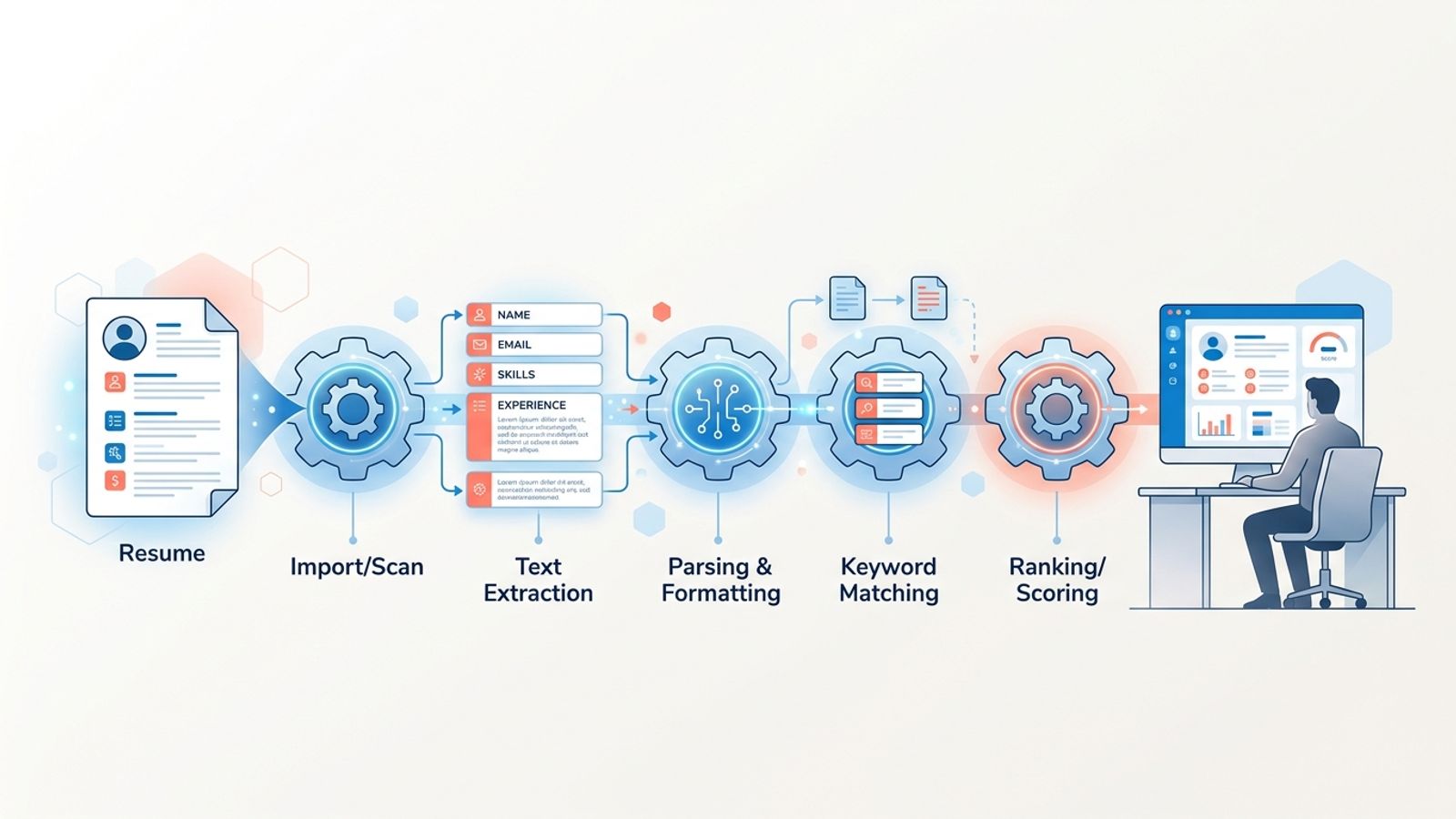
Your resume goes through 5 stages. Each one is a potential failure point.
| Stage | What Happens | Where It Can Break |
|---|---|---|
| 1. Upload | ATS receives your file (DOCX, PDF, or text) | Image-based PDFs (scanned) = 0% parseable. DOCX: 4% failure. PDF: 18% failure (CoverSentry) |
| 2. Parsing | Converts document into structured fields: name, email, job titles, skills, dates | Tables: 31% failure. Text boxes: content skipped. Headers/footers: contact info vanishes |
| 3. Keyword Matching | Extracts keywords from JD, checks how many appear in your resume | Average resume contains only 51% of relevant keywords from the posting |
| 4. Ranking | Applicants sorted by relevance. Recruiters see top 10-20% | Below the threshold = you exist in the database but nobody scrolls down to find you |
| 5. Human Review | Recruiter opens your resume, spends 7.4 seconds deciding | 54% of candidates send generic resumes. Recruiter moves on. |
Every ATS stores your original file alongside the parsed data. Recruiters CAN view your actual PDF even if parsing failed. The problem: they have to know you exist first. If your keywords parsed incorrectly, their search never surfaces your name.
The 75% Rejection Myth
The claim that "75% of resumes are automatically rejected by ATS" was invented by Preptel, a resume optimization company, as a sales pitch in 2012. Preptel went bankrupt in 2013. No methodology was ever published. A 2014 Forbes article cited it without verification, CIO.com cited Forbes, CNBC cited CIO.com. The stat went viral.
What the data actually says:
- 92% of recruiters confirm their ATS does NOT auto-reject resumes (Enhancv 2025, survey of 25 recruiters)
- Only 8% configure content-based auto-rejection, and only for strict criteria like "less than 75% skill match"
- 68% of recruiters first heard the 75% claim from job seekers on social media
- 20% blame career coaches and resume services recycling outdated advice
- Recruiter Charkin Whitehead (Allegis Global Solutions): "The ATS systems I have worked with don't automatically disposition people. We have to go in and do it."
ATS does not reject your resume. People do. The software is a filing cabinet. Whether anyone opens your drawer depends on what labels you put on it.
One company made up a number in 2012, went bankrupt a year later, and the career advice industry has been recycling it for 14 years. Nobody checked. A billion-dollar panic built on a dead company's marketing copy.
“ATS doesn't eliminate applications. It stores them.”
How Recruiters Actually Search ATS
Recruiters use Boolean search to find candidates in their ATS database, the same way you search Google. Understanding their search patterns tells you exactly what keywords your resume needs.
Common Boolean operators:
| Operator | What It Does | Example |
|---|---|---|
| AND | Both terms must appear | "project management" AND "Salesforce" |
| OR | Either term works | "UX designer" OR "UI designer" |
| NOT | Excludes a term | "developer" NOT "junior" |
| "Quotes" | Exact phrase match | "product manager" (not product + manager separately) |
| Wildcards (*) | Matches partial words | Develop* = developer, development, developing |
A real recruiter search looks like this: Analy* AND Financ* AND (Retail OR e-commerce) AND Excel AND (SQL OR "Business Objects"). If your resume uses "spreadsheet analysis" instead of "Excel," you are invisible to this search.
What recruiters filter by (Jobscan 2025, 384 recruiters): 76% filter by skills, 60% by education, 55% by previous job titles, 51% by certifications, 44% by years of experience, 43% by location. 99.7% use keyword filters.
A candidate who applies on day 10 can surface at the top of a filtered list ahead of someone who applied on day 1, if their keywords match the search better.
ATS Resume Format: What Passes
Formatting rules exist because of how ATS parsers read documents:
| Rule | Parsing Accuracy |
|---|---|
| Single column, standard headings | 93% (CoverSentry) |
| Two-column layout | 86% |
| Tables in DOCX | 69% (31% failure) |
| PDF with embedded fonts | 82% (18% failure) |
| Clean DOCX, no tables | 96% (4% failure) |
| Visual-heavy templates (Canva-style) | As low as 13% in Workday (Reddit experiment) |
Standard section headings that ATS recognizes: "Work Experience," "Professional Experience," "Education," "Skills," "Certifications." Creative alternatives ("Where I Have Been," "What I Bring") cause the parser to miscategorize entire sections.
For specific template recommendations, see our ATS-friendly resume template guide with free downloads and system-specific formatting rules.
Resume Keywords for ATS
The average resume contains only 51% of relevant keywords from the job posting (Cultivated Culture, 125K resume analysis). That gap is the single biggest reason resumes don't surface in recruiter searches.
The 3-Part Keyword Strategy
1. Extract: pull exact terms from the job description. Hard skills, tools, certifications, industry jargon. If the JD says "Salesforce CRM administration," your resume needs those exact words, not "CRM management."
2. Map: match extracted keywords to your actual experience. Only include keywords for skills you genuinely have.
3. Place: distribute keywords across Summary, Skills, and Experience sections. Mentioning "Python" once in your Skills section is good. Mentioning it in Skills AND in an experience bullet ("Built ETL pipeline in Python processing 2M records/day") is better. Context counts.
Where Keywords Matter Most
| Section | Keyword Impact | Why |
|---|---|---|
| Job Title | Critical | Matching job title = 3.5x more likely to get interview (Jobscan, 1M applications) |
| Professional Summary | Very High | Top of resume, heavily weighted by most ATS |
| Skills Section | Very High | Direct extraction zone for keyword matching |
| Work Experience | Very High | Shows keywords in context with measurable results |
| Education | Medium | Degree names, certifications |
Include both acronyms and full terms: "Enterprise Resource Planning (ERP)" covers both search patterns. 66% of ATS cannot understand synonyms (CoverSentry). Mirror the job description exactly.
How to Beat ATS (the Real Way)
"Beating" ATS is a misleading framing. You're not fighting a robot. You're making yourself findable in a database where 99.7% of recruiters search by keywords. Stop looking for tricks. Just match the words they search for.
- Tailor every resume. Tailored resumes get 11.7% callback vs 4.2% for generic (CoverSentry, 15,000 applications). That is a 3x difference.
- Match the job title. Candidates whose resume title matches the posting title are 3.5x more likely to get an interview (Jobscan).
- Use the job description's language. If they say "cross-functional collaboration," don't write "worked with other teams."
- Target 80%+ keyword match. 15-25 relevant keywords per resume. Check by comparing your resume to the posting term by term.
- Submit DOCX when possible. 4% failure rate vs 18% for PDF (CoverSentry).
- Don't hide keywords in white text. Modern ATS displays all text in the same color on the recruiter's screen. ManpowerGroup catches this in ~10% of resumes they scan.
One thing beats all of this: knowing someone. Referrals are 7% of the candidate pool but 40% of hires (Zippia). A referral skips the database entirely. Someone hands your resume to the hiring manager. No parsing, no keywords, no ranking algorithm. Just a human saying "talk to this person."
Referrals dodge the 180-applicant crush by skipping the database. There's a second dodge that costs nothing: apply where the crowd isn't. Most of that 180 piles onto the same reposted listings on the big aggregators, days after the role went up. Pulling roles straight from company career pages gets you in earlier and into smaller pools, and skipping ghost listings means you're not spending keyword-perfect resumes on jobs nobody's filling. A search that ranks live openings against your resume does both. Mirrai's AI Job Search reads roles straight from career pages, flags the stale and ghost ones, and shows the match, so your tailored resume lands in a queue of 30 instead of 300.
“Direct messaging hiring managers has a 10-15% response rate, 5x better than blind applications.”
Knockout Questions: The Real Automatic Filter
The only legitimate automatic rejection in most ATS comes from knockout questions on the application form, not from resume scanning.
Knockout questions are yes/no or multiple-choice: "Are you authorized to work in the US?" "Do you hold a valid PMP certification?" "Do you have 3+ years in project management?" Answer wrong and you are automatically disqualified. 84% of recruiters use knockout questions for work authorization, certifications, or location requirements (Enhancv).
This is a separate system from resume parsing. Your resume can be perfectly formatted with 100% keyword match, and a knockout question still eliminates you. Read every question carefully. If a required certification is listed and you don't have it, the knockout question will catch it regardless of what your resume says.
ATS by System
| System | Fortune 500 Share | Key Behavior |
|---|---|---|
| Workday | 39% | Strictest parser. Expects standard headers + chronological structure. Many employers run older versions with less tolerance. |
| SuccessFactors (SAP) | 13.2% | Mid-range parsing. Education and skills sections weighted heavily. |
| Taleo (Oracle) | 10.2% | Only major ATS with automated ranking ("requisition rank"). DOCX strongly preferred. PDF unreliable. Single column only. |
| iCIMS | 7.4% | Auto-generates skills list from full text. Keywords in experience bullets get indexed even without a dedicated Skills section. |
| Greenhouse | Growing | No auto-scoring. Recruiters see your actual uploaded document. Human-driven scorecards. |
| Lever | Growing | Holistic candidate profile (resume + cover letter + referrals). Most formatting-tolerant of major systems. |
Check how your resume parses against any job description. See your match score in 30 seconds.
Before you leave
See how your resume stacks up
Paste any job description and get your match score in 30 seconds.
Try FreeFree month of Pro with code LAUNCH
FAQ
Does ATS automatically reject resumes?
What is a good ATS score?
Should I use white text to hide keywords?
PDF or DOCX for ATS?
How many keywords should my resume have?
Can I bypass ATS entirely?
If ATS isn't the problem, what is?
Build a resume optimized for any ATS. Try Mirrai's free Resume Builder. It matches your experience to the job description and handles ATS formatting automatically.
Getting past ATS is step one. Step two is tailoring your resume for each specific job. How to tailor your resume to a job description covers the keyword-matching process in detail.