Mirrai Careers
How to Tailor Your Resume to a Job Description (2026)
75% of resumes are rejected by ATS before a human sees them. Tailored resumes get 61% more interviews. Here's how to do it in 20 minutes.

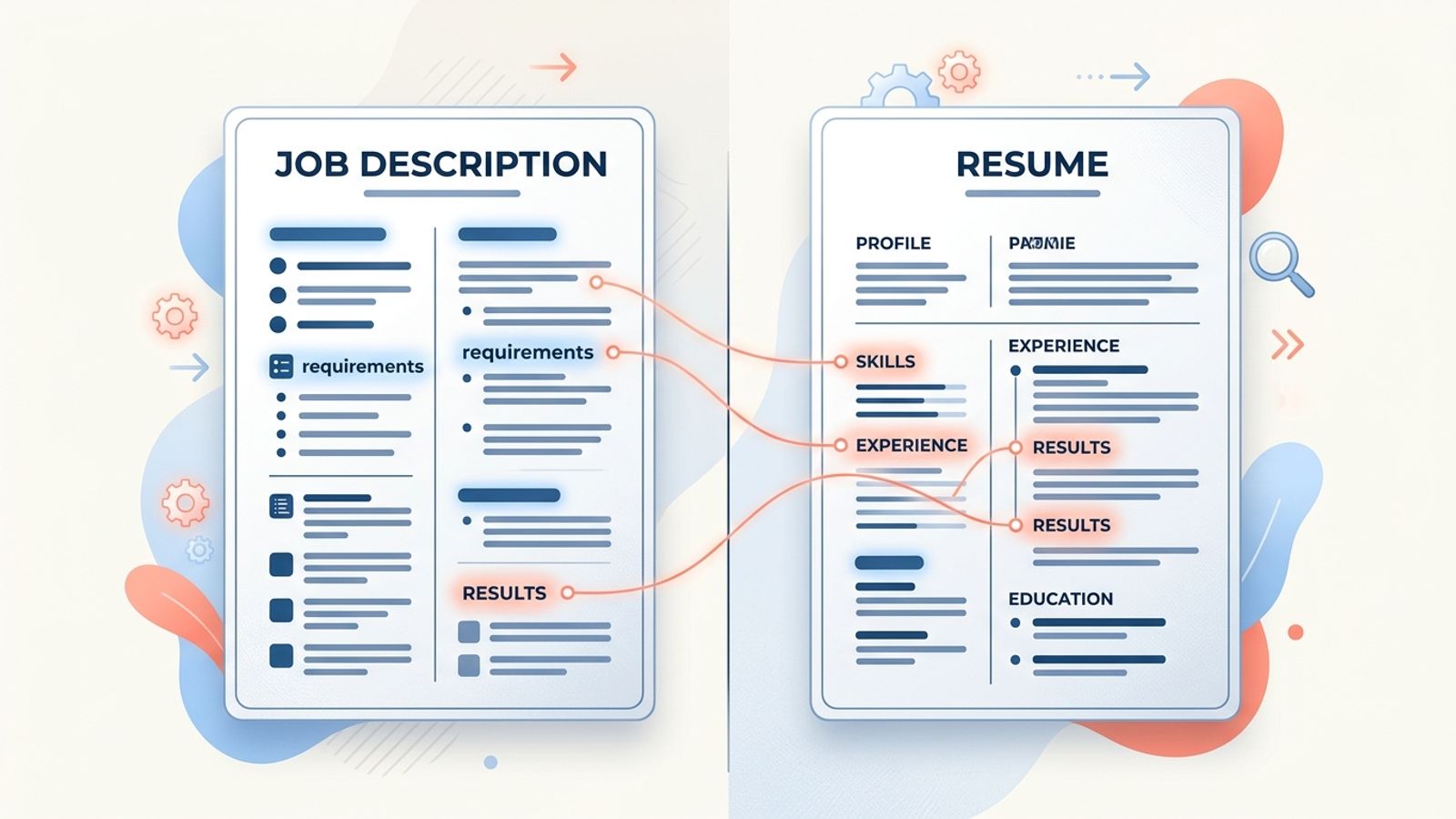
75% of resumes get rejected by ATS before a human ever sees them (Jobscan, 2023). The main reason isn't that applicants are unqualified. It's that their resumes don't contain the right keywords in the right places. The software reads your resume like a checklist, and if the words don't match the job description, you're out.
Tailored resumes get 61% more interviews than generic ones (TopResume, 2023). A resume with keywords matching the job description is 3x more likely to get a callback (Jobscan, 2024). These aren't small differences. For most people, the gap between "no responses" and "three interviews this week" is 20 minutes of editing per application.
That's what this guide covers: how to read a job description, pull out what matters, and rewrite your resume to match. No fluff, just the process.
Mirrai Careers
Match your resume to any job in seconds
Upload your resume, paste a job description, see your match score.
Try FreeFree month of Pro with code LAUNCH
Why Tailoring Your Resume Actually Matters
Recruiters spend 6-7 seconds on your resume (TheLadders eye-tracking study, 2018). In that time, they check your current title, company, dates, and education. If nothing jumps out as relevant to the role they're filling, you're in the no pile. A tailored resume puts the relevant information exactly where their eyes land first.
But the human is the second gatekeeper. The first one is the ATS. Over 99% of Fortune 500 companies use applicant tracking systems (Jobscan, 2023). These systems scan your resume for keywords from the job description and score you on how well you match. A 2021 study by Harvard Business School and Accenture found that 27 million US workers were effectively invisible to employers because ATS filters screened them out on rigid keyword criteria. Qualified people, rejected by software.
63% of recruiters say they prefer resumes tailored to the specific position (JobVite Recruiter Nation Survey, 2020). They can tell. The same way you can tell when someone sends you a mass text pretending it's personal. Except this one costs you an interview.
For a full breakdown of how ATS systems work and how to format your resume for them, see our ATS resume guide.
How to Tailor Your Resume to a Job Description (Step by Step)
This takes 15-20 minutes once you get the hang of it. The first time might take 30-40 minutes. By your fifth application, it'll feel automatic.
1. Read the Job Description Twice
First read: understand what the role actually is. What team, what problems, what level.
Second read: with a highlighter (or just mental notes). You're looking for three categories:
- Required skills and tools (Python, Salesforce, Google Analytics, whatever shows up)
- Responsibilities that match things you've actually done
- Soft requirements buried in the language ("fast-paced" = high workload, "self-starter" = no training, "cross-functional" = you'll deal with a lot of people)
The job description is a keyword list wearing a suit. Your job is to strip it down to the actual requirements.
2. Pull Out the Keywords
Make a list of every specific skill, tool, certification, and responsibility mentioned. Pay attention to what shows up more than once. If "stakeholder management" appears in the title, the responsibilities, AND the requirements, that phrase needs to be in your resume.
A rough hierarchy of keyword importance:
| Priority | Type | Example |
|---|---|---|
| Highest | Skills mentioned in requirements AND responsibilities | "project management," "SQL," "budget forecasting" |
| High | Tools and platforms named specifically | "Jira," "Tableau," "HubSpot" |
| Medium | Industry terms and certifications | "PMP," "Agile," "SOC 2 compliance" |
| Lower | Soft skills and culture descriptors | "collaborative," "detail-oriented," "fast-paced" |
Don't just grab the nouns. Look at the verbs too. "Manage" vs "support" vs "lead" vs "assist" tells you the seniority level they expect. Match your language to theirs.
3. Rewrite Your Summary
Your resume summary (the 2-3 sentences at the top) is prime real estate. Most people write it once and never touch it again. That's a waste.
Take your top 2-3 keywords from step 2 and work them into the summary naturally. If the job asks for "data-driven marketing manager with B2B SaaS experience," your summary should contain those exact phrases, backed by a number.
Generic: "Experienced marketing professional with a track record of success."
Tailored: "Marketing manager with 6 years in B2B SaaS. Grew pipeline 40% through data-driven campaigns targeting enterprise accounts."
Same person. Different language. The second one matches the job description and gives the recruiter a reason to keep reading.
Need more examples? We have a full list of resume summary examples across different industries.
4. Match Your Skills Section
This is the easiest part of the whole process and somehow the one people skip most often. Five minutes of work. Massive impact.
If the JD says "proficient in Excel," don't write "Microsoft Office Suite." Write "Excel." If it says "Google Analytics," don't write "web analytics tools." ATS systems are literal. Many of them can't match synonyms. A Jobscan analysis found that resumes matching 80%+ of JD keywords pass ATS screening at 2.5x the rate of those below 50%.
For guidance on which skills to include and how to organize them, check our guide on skills to put on a resume.
5. Adjust Your Bullet Points
You don't need to rewrite every bullet. Focus on the 3-5 that are most relevant to the target role.
The formula: [Action verb from JD] + [What you did] + [Measurable result]
- JD says "manage cross-functional projects." Your bullet: "Managed 4 cross-functional projects involving engineering, design, and marketing teams, delivering all on time."
- JD says "analyze customer data to drive decisions." Your bullet: "Analyzed customer behavior data across 50K accounts to identify churn signals, reducing cancellations by 18%."
If a bullet point on your resume has zero connection to the job you're applying for, move it down or cut it. Recruiters have 6 seconds. Don't make them spend it reading about your 2019 event planning experience when the role is in data analytics.
6. Check Your Title Alignment
If your actual job title was "Marketing Coordinator" and the role you want is "Marketing Manager," you can't fake your title. But you can clarify scope.
"Marketing Coordinator (Team Lead, 4 direct reports)" tells a different story than just "Marketing Coordinator." You're not lying. You're providing context that the ATS and recruiter both need to see.
Before and After: Resume Tailoring Example
Job description excerpt: "Seeking a Product Manager with experience in B2B SaaS, Agile methodology, data-driven decision making, and stakeholder management."
| Section | Before (Generic) | After (Tailored) |
|---|---|---|
| Summary | Results-oriented professional with 7 years of experience in product development and team leadership. | Product Manager with 7 years in B2B SaaS. Led Agile teams of 8, drove roadmap decisions using product analytics, and managed stakeholder alignment across engineering, sales, and executive teams. |
| Skills | Product Management, Leadership, Strategy, Communication, Problem Solving | B2B SaaS Product Management, Agile/Scrum, Stakeholder Management, Product Analytics (Mixpanel, Amplitude), Data-Driven Roadmap Planning |
| Top Bullet | Managed product development lifecycle from ideation to launch. | Owned end-to-end product lifecycle for B2B SaaS platform ($2M ARR), using Agile sprints and data-driven prioritization to ship 12 features in 6 months. |
Same person, same job, same seven years. Every edit took under 5 minutes. The tailored version hits four keywords from the JD directly. The generic version? A recruiter would read it, think "could be anyone," and move on. That's the difference between getting an interview and getting silence.
Resume Tailoring Tools
You can do all of this manually. Takes about 20 minutes per application. But if you're applying to 15-30 jobs, that's 5-10 hours of copy-pasting keywords and reformatting bullet points. Life is short.
Before you spend that time, point it at the right roles. Tailoring for a job you match 40% of is 20 minutes you won't get back, and most people spend them anyway. Mirrai's AI Job Search reads roles straight from company career pages and ranks them against your resume, so you see the match before you commit. Tailor the ones that clear the bar. Skip the 40% matches that were never going to call you back.
What to look for in a resume tailoring tool:
- JD analysis that extracts keywords automatically instead of making you guess
- Match scoring so you can see gaps before you submit
- The ability to keep multiple versions without losing your original
- Export to clean PDF that won't break ATS formatting
Mirrai's Job Matcher does exactly this: paste a job description, and it shows you where your resume matches and where it doesn't. You can fix the gaps right there and export a tailored version.
Whatever tool you use, don't outsource your judgment entirely. AI can match keywords, but only you know which of your experiences actually maps to the role. Use tools to save time on the mechanical parts. The strategic decisions are still yours.
Before you leave
See how your resume stacks up
Paste any job description and get your match score in 30 seconds.
Try FreeFree month of Pro with code LAUNCH
FAQ
How much should I change my resume for each job?
Should I use the exact same words as the job description?
Is it worth tailoring if I'm sending lots of applications?
Can ATS tell if I copied keywords from the job description?
What if my experience doesn't match the job description well?
How do I find the right jobs to tailor my resume for?
Stop guessing which keywords matter. Mirrai's Job Matcher analyzes any job description and shows you exactly where your resume fits and where it doesn't. Takes 30 seconds.