Mirrai Careers
Best Font for Resume: Sizes, Spacing & What ATS Can Read (2026)
88% of recruiters have rejected resumes for font and formatting choices alone. Here are the 10 safest fonts, exact sizes for every section, and what ATS can parse.

Updated June 2026
Added Aptos vs Calibri analysis (Microsoft's January 2024 default switch), industry-specific font picks, and heading-body pairings.
88% of recruiters have rejected resumes based on font and formatting choices alone (Resume Genius, 2024 survey of 500+ recruiters). 63% prefer sans-serif fonts for digital submissions. And 7.4 seconds is all you get before they decide to keep reading or move on (Ladders eye-tracking study).
Your font affects whether ATS can parse your resume, whether a recruiter can read it in their 7-second scan, and whether you look competent or like someone who just discovered WordArt.
Nobody got rejected for using Calibri. People get rejected for using Papyrus. The bar is low. Clear it.
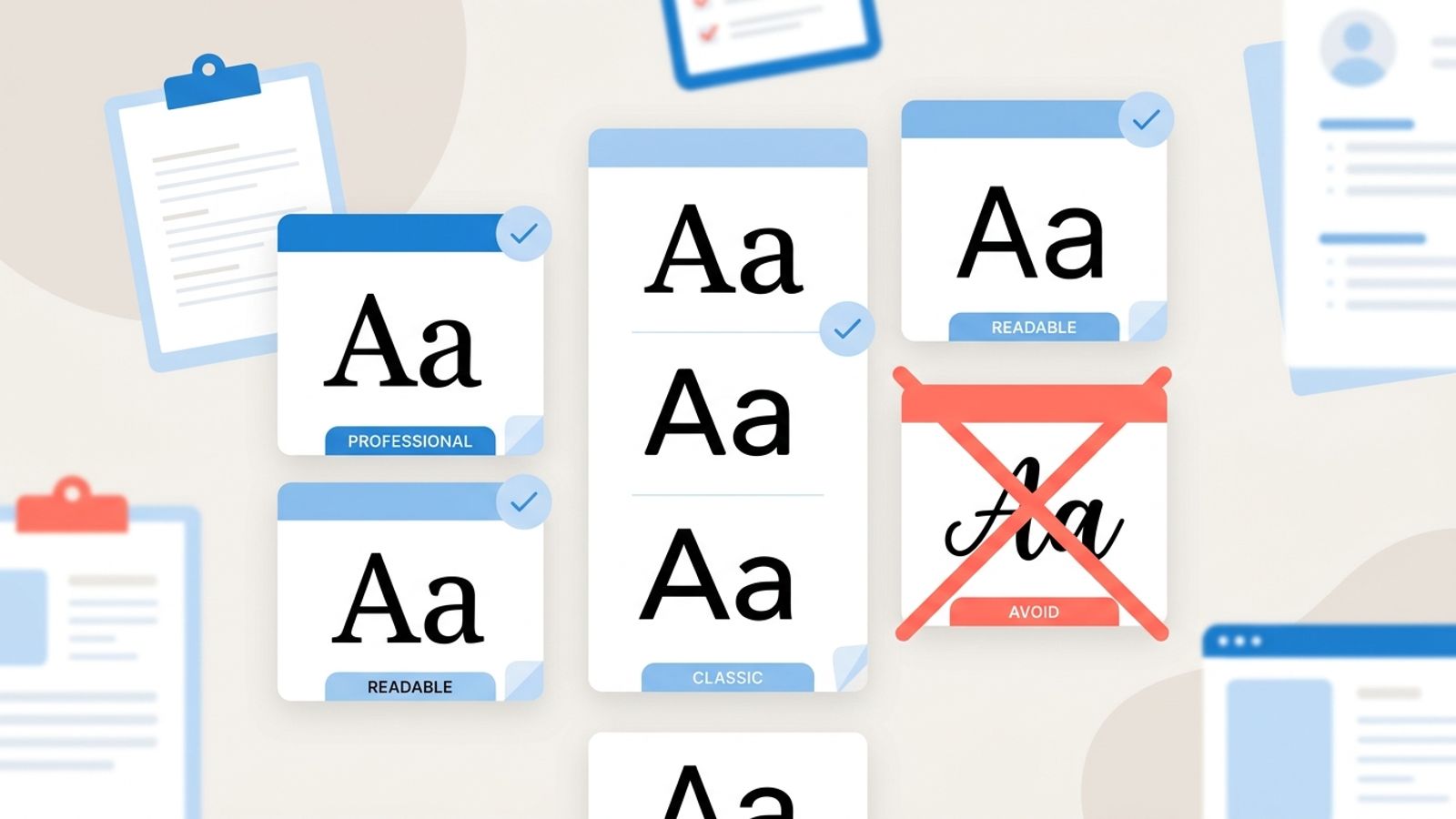
Below: the 10 safest fonts, exact sizes for every section, fonts that will get you rejected, and how fonts interact with ATS.
Mirrai Careers
Match your resume to any job in seconds
Upload your resume, paste a job description, see your match score.
Try FreeFree month of Pro with code LAUNCH
10 Best Fonts for a Resume in 2026
Sans-Serif (modern, screen-first)
| Font | Why It Works | Best For |
|---|---|---|
| Calibri | Corporate standard since 2007. Clean, neutral, installed everywhere | Corporate, tech, general use |
| Arial | Used by 80%+ of job seekers (Resume Genius). Near-perfect ATS parsing | Any industry. Safest possible choice |
| Aptos | Replaced Calibri as Microsoft 365 default in 2023. Warmer, modern | Anyone using current Word templates |
| Helvetica | Most readable sans-serif according to designers. Not on Windows natively (use Arial) | Design, creative, marketing |
| Lato | "Serious but friendly." Fresher than Arial. May not render on all machines | Tech, startups, Google Docs users |
| Verdana | Wider spacing, extremely readable at small sizes | Dense resumes viewed on screen |
| Montserrat | Geometric, modern personality. Saves space vs Arial at same size | Creative fields, startups |
Serif (traditional, formal)
| Font | Why It Works | Best For |
|---|---|---|
| Georgia | Designed by Microsoft for screen readability. Legible even on phones | Traditional industries reading digitally |
| Garamond | Thinner, fits more text per page. Signals formality | Academia, law, finance, executive roles |
| Cambria | Designed for on-screen reading. Pairs with Calibri. Reliable ATS parsing | Conservative industries, government |
Serif or sans-serif? Studies show serif reads slightly faster in print, sans-serif slightly faster on screens (BHI Group / ACM). Most resumes get read on a screen first, so sans-serif has a small edge. But honestly, either works. Obsessing over serif vs. sans-serif is a distraction from things that actually matter, like size and spacing.
“I have it with calibri right now but I found montserrat is just as readable and looks arguably better while somehow saving enough space to add another experience. Was wondering if there's anything wrong with montserrat as a font ATS and scanning wise”
Aptos vs Calibri in 2026
Calibri was the Microsoft Office default for 17 years. In January 2024 Microsoft replaced it with Aptos (CNN, February 2024). Aptos was designed by Steve Matteson, the same designer behind Segoe and the original Windows TrueType cores. By mid-2026, Aptos is the font most recruiters open without thinking about it.
What this means for your resume:
- If you built your resume in Word any time before mid-2024 and never changed the font, it is in Calibri. Still legible, still ATS-safe. Just looks like an older template.
- If you started fresh in Word 2024 or later, you got Aptos by default. Slightly narrower at the same point size, slightly more modern shapes (single-story lowercase "a", single-loop "g").
- Both parse cleanly in Workday, Greenhouse, Lever, and Taleo. Neither will get you filtered out.
Practical test: 500 words of body text at 11pt fits in about 6% less vertical space in Aptos than in Calibri. If your resume is overflowing onto a second page by a few lines, switching from Calibri to Aptos can pull it back to one page without changing the content.
“Switched mine from Calibri to Aptos and went from 1.5 pages to 1 page with no content changes. Same recruiter feedback. Aptos is just denser.”
Industry-Specific Font Picks
Both Aptos and Calibri work everywhere. But certain industries respond better to specific tones. Font is part of how recruiters categorize you in the first 3 seconds, before they read a word.
| Industry | Top Pick | Alternative | Why |
|---|---|---|---|
| Tech, startups, product | Aptos | Calibri, Lato | Modern, dense, matches current Microsoft templates |
| Finance, consulting | Calibri | Garamond, Cambria | Universally recognized as professional |
| Law, government, executive | Garamond | Cambria, Times New Roman | Serif signals authority and tradition |
| Healthcare, education | Calibri | Georgia, Arial | Conservative without being old-fashioned |
| Creative, design, marketing | Helvetica | Montserrat | Designers will notice your type choice; pick one that holds up |
| Academia, research | Garamond | Cambria | Serif is the academic dialect; sans-serif reads as corporate |
| Sales, account management | Arial | Calibri | Safest possible — your numbers are the differentiator |
When in doubt: Calibri for conservative industries, Aptos for anything tech-adjacent, Arial when you genuinely cannot tell which side the company falls on.
In tech and research where the first reader is a senior engineer, LaTeX templates like Jake's Resume are the common choice. They signal comfort with the tools and produce typography that beats what Word can do.
Font Pairings: Headings + Body
One font for the whole resume is the safest play. But if you want a hint of typographic care without going off the rails, pair one sans-serif with one serif. The combinations below all parse cleanly across the four major ATS systems.
| Headings | Body | Best For |
|---|---|---|
| Calibri Bold | Cambria | Corporate, finance, consulting |
| Aptos Display | Aptos | Tech, startups, modern roles |
| Montserrat | Open Sans | Creative, startup, design |
| Georgia Bold | Lato | Marketing, content, branding |
| Garamond | Garamond | Law, academia, executive |
Two rules: maximum two fonts (a third looks chaotic), and the two should contrast visibly. Calibri Light paired with Calibri Regular gives you no real hierarchy. Calibri paired with Cambria reads like an intentional choice.
Resume Font Size: What to Use Where
| Element | Size | Notes |
|---|---|---|
| Your name | 18-24 pt | Largest element on the page. Bold. First thing the eye finds |
| Section headings | 12-14 pt | Bold or uppercase. Consistent across all sections |
| Body text | 10.5-12 pt | 11 pt is the sweet spot for most fonts. Never below 10 pt |
| Bullet points | 10-11 pt | Same as or slightly smaller than body text |
| Contact info | 9-10 pt | Phone, email, LinkedIn, location. Smaller than body |
Why 10 pt minimum? Recruiters scanning at speed skip text they have to squint at. And some ATS parsers choke on anything smaller. Go below 10 pt and you're optimizing for density at the cost of being read.
Garamond runs smaller than other fonts at the same point size. If using Garamond, bump everything up by 0.5-1 pt. Verdana runs larger. If using Verdana, you can go 0.5 pt smaller.
“We read the resumes ourselves and usually discard the 10 page ones in favor of the 1-2 page ones. I know a dart board when I see one. 10 pages at 10pt font ain't it.”
Spacing and Margins
| Setting | Recommended | Acceptable Range |
|---|---|---|
| Margins (all sides) | 1 inch (2.54 cm) | 0.5" to 1" |
| Body line spacing | 1.0 to 1.15 | Single to slightly open |
| Between sections | 8-12 pt paragraph spacing | Enough to visually separate sections |
| After headings | Small gap before body text begins | 1.5 line spacing, then back to 1.0 |
Margins below 0.5 inch get clipped by printers and some ATS parsers. White space matters: resumes with clear visual hierarchy got 60% more recruiter attention than wall-of-text alternatives (Ladders eye-tracking study). Stop cramming.
Opposite margins should mirror each other. Left = Right, Top = Bottom. Uneven margins look sloppy and signal carelessness.
Fonts That Get Your Resume Rejected
| Font | Why It Fails |
|---|---|
| Comic Sans | Designed in 1994 for a cartoon dog. Universally mocked by recruiters |
| Papyrus | Dated, strongly associated with amateur design |
| Brush Script | Decorative script. ATS cannot parse it. Illegible at small sizes |
| Impact | Extremely tight spacing. Hard to read, harder to parse |
| Courier / Courier New | Monospaced typewriter font. Wastes space, looks like 1975 |
| Lucida Handwriting | Script font. ATS parsing failure. Too informal for any professional document |
| Curlz MT | Decorative, unreadable. Just... no |
The general rule from CNBC (citing typographers): avoid any font with a "flowery, fun, funky, or flashy feel." If the font has personality, your resume has the wrong kind of personality.
How Fonts Affect ATS Parsing
92% of recruiters say their ATS does not auto-reject resumes for formatting (Jobscan, 2024). But that stat is misleading. ATS doesn't reject your resume. It garbles it. Your name becomes "S4r@h J0hns0n." Your job title disappears. Your skills section merges with your education. The recruiter sees garbage and moves on.
Why fonts cause parsing failures:
- Decorative fonts have complex character shapes that confuse character recognition
- Custom fonts may not embed properly in PDFs, resulting in lost text
- Tight spacing (condensed fonts) causes letters to merge during parsing
- Ligatures (where "fi" or "fl" render as a single character) can break keyword extraction
- Non-standard fonts installed on your machine may not exist on the recruiter's system, causing substitution
ATS-safe fonts (confirmed across major platforms like Workday, Greenhouse, Lever, Taleo): Arial, Calibri, Cambria, Georgia, Helvetica, Times New Roman, Verdana, Garamond, Tahoma, Trebuchet MS.
“I learned that I should use a ligature free font like Arial and use save to PDF instead of Print to PDF to make my resume readable for ATS software.”
Check if your resume's formatting passes ATS. Paste any job description and see your match score in 30 seconds.
Before you leave
See how your resume stacks up
Paste any job description and get your match score in 30 seconds.
Try FreeFree month of Pro with code LAUNCH
FAQ
Is Aptos better than Calibri for resumes in 2026?
Do different industries actually care about font choice?
What is the single safest resume font?
Should I use the same font throughout my resume?
Does font choice matter more than content?
Is Times New Roman outdated?
Can I use Google Fonts like Lato or Montserrat?
Build a resume with ATS-safe formatting automatically. Try Mirrai's free Resume Builder.