Mirrai Careers
Resume Objective vs Summary: Which to Use in 2026
Objectives say what you want. Summaries say what you bring. In 2026, summaries win for 90% of people. Here's when each makes sense.

Updated June 2026
Added a quick decision callout near the top and 2 new FAQs answering the most common phrasing of the question.
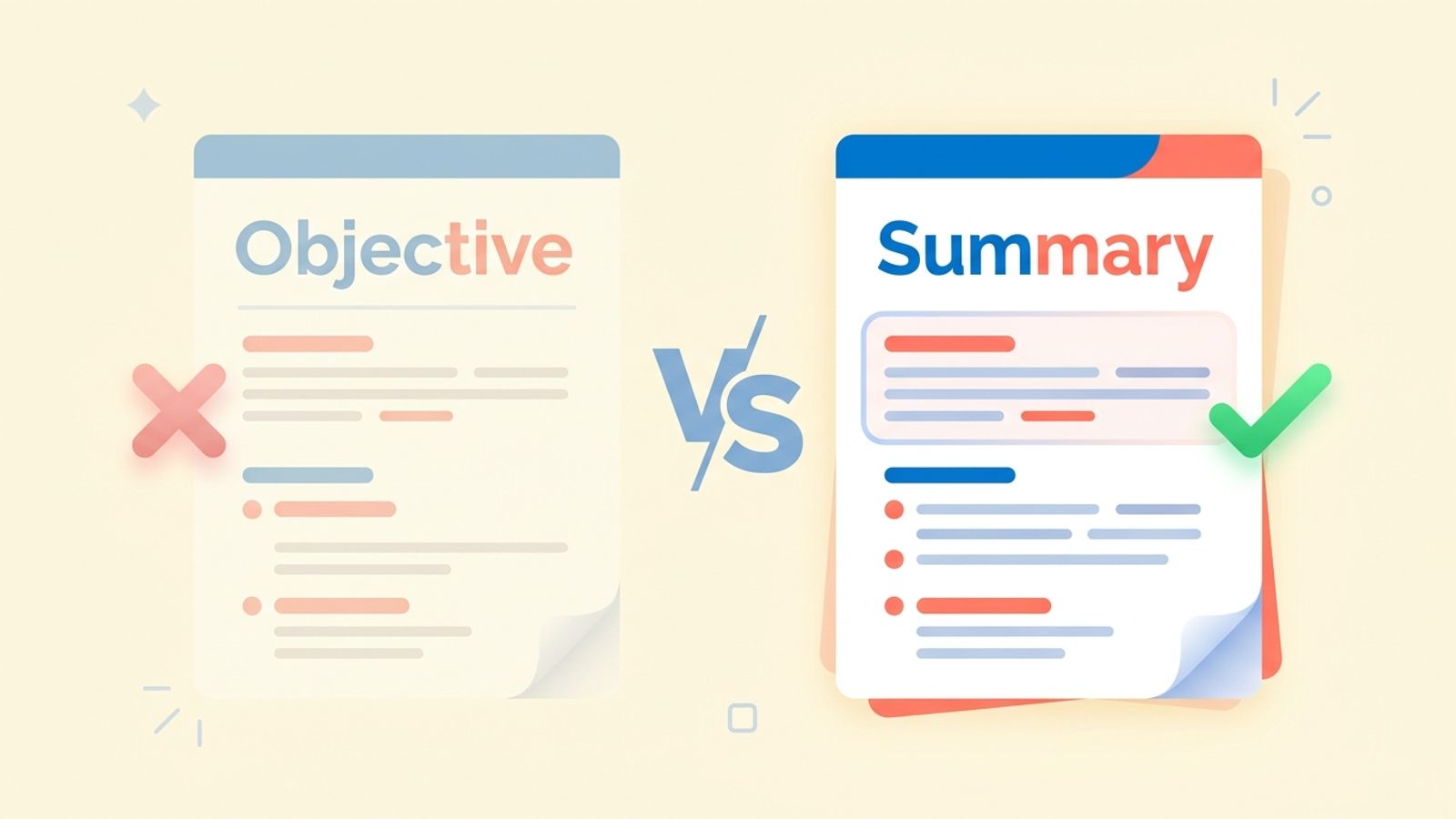
An objective tells the employer what you want. A summary tells the employer what you bring. In 2026, that distinction decides which one belongs on your resume.
The short version: summaries have won. Resumes with professional summaries get 340% more callbacks than those with objectives (The Interview Guys). Objectives were standard in the 1990s and 2000s but have fallen out of favor because they center on the candidate's needs, not the employer's. Hiring managers don't care what you're "seeking." They care what you can do for them.
But objectives aren't completely dead. There are two specific situations where they still work. Everything else? Summary.
Quick Decision
Have professional experience? Use a summary. No work experience yet (recent grad)? Use an objective. Career changer with non-matching experience? Use an objective (to explain the pivot). Anything else? Use a summary.
Mirrai Careers
Match your resume to any job in seconds
Upload your resume, paste a job description, see your match score.
Try FreeFree month of Pro with code LAUNCH
Resume Objective vs Summary: The Difference
| Resume Objective | Resume Summary | |
|---|---|---|
| Purpose | States what YOU want from the job | States what YOU BRING to the job |
| Focus | Candidate-centered | Employer-centered |
| Length | 1-2 sentences | 2-4 sentences |
| Contains | Goal, desired role, desired industry | Skills, experience, achievements, numbers |
| Best for | Career changers, entry-level with no experience | Everyone else (90%+ of job seekers) |
| Callback rate | Lower (vague, self-focused) | 340% higher than objectives (The Interview Guys) |
An objective says: "Seeking a challenging marketing position where I can utilize my skills and grow professionally."
A summary says: "Marketing manager with 6 years in B2B SaaS. Grew pipeline 40% through data-driven campaigns targeting enterprise accounts."
One describes a wish. The other describes a track record. You can guess which one makes the recruiter keep reading.
When to Use a Resume Summary (Most People)
If you have any professional experience at all, use a summary. That's the default.
“"You need a summary." More often than not, this is how I've begun my critiques on this subreddit for over 4 years now. Summaries provide an anchor for the reader. Unless you trust a recruiter to get a perfect overview of you in their patented "six second scan," the summary is your best chance of saying "this is who I am as a professional."”
A good summary does three things in 3-5 lines:
- Names your role and years of experience ("Product manager with 7 years in B2B SaaS")
- Highlights 1-2 key achievements with numbers ("grew activation 28%, managed 15K-user platform")
- Signals what you're good at and what kind of work you do ("Agile teams, data-driven roadmap planning, stakeholder management")
The summary is the most-read section after your name and title. Make it count. "Results-oriented professional with a track record of success" technically qualifies as a summary. It also says nothing about you that couldn't be said about every other applicant.
Full examples across industries: resume summary examples.
When to Use a Resume Objective (Two Cases)
Objectives still make sense in exactly two situations:
1. You Have Zero Work Experience
A recent graduate with no internships and no relevant jobs can't write a summary because there's nothing to summarize. An objective fills the gap by explaining what you're looking for and what relevant skills or coursework you bring.
Entry-Level Objective
"Recent marketing graduate from [University] seeking an entry-level marketing coordinator position. Coursework in digital analytics and content strategy, plus hands-on experience managing social media for a student consulting group (grew LinkedIn following from 200 to 2,400)."
Notice it still includes a specific achievement. Even an objective should prove something.
2. You're Making a Career Change
When your experience is in a different field, a summary of that experience might confuse the recruiter about why you're applying. An objective bridges the gap by explaining the pivot.
Career Change Objective
"Experienced teacher with 8 years of curriculum design and student data analysis, transitioning to UX research. Completed Google UX Design Certificate and freelanced on 2 SaaS onboarding redesign projects. Seeking a UX researcher role where I can apply my background in user empathy and information architecture."
This works because it acknowledges the change, shows preparation, and connects old skills to the new role.
More on career transitions: career change at 40.
Side by Side: Objective vs Summary for the Same Person
Mid-Career Marketing Professional
| Objective (Weak) | Summary (Strong) | |
|---|---|---|
| Text | "Seeking a senior marketing position at a growing company where I can leverage my skills in digital marketing and team leadership." | "Senior digital marketer with 8 years of experience in B2B SaaS. Led a team of 5 that grew organic traffic 200% and generated $3.2M in pipeline over 18 months. Specialized in SEO, content strategy, and marketing automation (HubSpot, Marketo)." |
| Problem | Says what they want. Names no achievements. Could be anyone. | Says what they bring. Has numbers. Shows specific expertise. |
Recent Graduate
| Bad Objective | Better Objective | |
|---|---|---|
| Text | "Seeking an entry-level position where I can utilize my communication skills and grow my career." | "Computer Science graduate from [University] seeking a junior software engineering role. Built 3 full-stack projects (React, Node.js, PostgreSQL) and completed a summer internship at [Company] where I shipped a feature used by 2,000 users." |
| Difference | Generic, no specifics, could apply to any job in any field. | Names the field, lists real skills, includes proof. |
Before you leave
See how your resume stacks up
Paste any job description and get your match score in 30 seconds.
Try FreeFree month of Pro with code LAUNCH
FAQ
Career Objective vs Professional Summary: Same Thing, Different Names
Some job sites still use the older terminology ("career objective" and "professional summary"), which is the same split as objective vs summary, just with adjectives attached. A career objective is the same as a resume objective: what you want. A professional summary is the same as a resume summary: what you bring. Indeed uses both terms interchangeably across its templates. So does most ATS guidance written before 2020.
If the job description or application form asks for a "career objective," treat it as an objective and follow the rules for one (1-2 sentences, candidate-focused, used by new grads or career changers). If it asks for a "professional summary," treat it as a summary (3-5 sentences, employer-focused, real numbers). The label is cosmetic. The content rules are the same.
How Long Should a Resume Objective or Summary Be?
Short answer: the objective is 1-2 sentences, the summary is 3-5 sentences. Neither should run longer than 80 words, and anything past 6 lines on the page is too long. Recruiters spend roughly 6-8 seconds on the first scan of a resume (a Ladders eye-tracking finding that gets cited everywhere because it has held up). They are not going to read a paragraph.
| Section | Sentences | Word count | Lines on the page |
|---|---|---|---|
| Resume objective | 1-2 | 20-40 | 1-2 |
| Resume summary (entry-level) | 2-3 | 30-50 | 2-3 |
| Resume summary (mid-career) | 3-5 | 50-70 | 3-5 |
| Resume summary (senior/executive) | 4-5 | 60-80 | 4-5 |
More senior candidates can push to 5 lines because they have more credentials to compress. Junior candidates trying to hit 5 lines usually end up padding with adjectives ("dedicated," "passionate," "results-driven") that say nothing. If you can describe what you do in 3 lines, do it in 3 lines.
The 80-Word Test
If your summary is over 80 words, you are writing a cover letter, not a summary. Cut it. The cover letter goes in the cover letter field. The summary is for the top of the resume.
15 Career Objective Examples by Situation
Objectives only earn their keep in two cases (no professional experience yet, or a deliberate career change). The examples below cover both. Every one includes at least one specific detail: a project, a course, a number, a tool. An objective without proof is just a wish, and recruiters read enough wishes.
Recent Graduate: Marketing
"Recent marketing graduate from NYU with coursework in digital analytics and consumer behavior. Managed social media for a 4-person student consulting team, growing LinkedIn following from 200 to 2,400 in one semester. Seeking an entry-level marketing coordinator role to build on content strategy and SEO experience."
Recent Graduate: Software Engineering
"Computer Science graduate from UT Austin with a focus on backend systems. Built 3 full-stack projects (React, Node.js, Postgres) and completed a summer internship at Shopify shipping a feature used by 2,000 merchants. Seeking a junior software engineer role on a backend or full-stack team."
Recent Graduate: Finance
"Finance graduate from UIUC with a 3.8 GPA and a concentration in corporate finance. Completed a Big Four audit internship and built a DCF model for a public-comp valuation project that placed top-5 in the campus stock-pitch competition. Seeking an investment banking analyst role at a mid-market firm."
Career Changer: Teacher to UX
"High school teacher with 7 years of curriculum design and student data analysis, transitioning to UX research. Completed the Google UX Design Certificate and freelanced on 2 SaaS onboarding redesigns. Seeking a UX researcher role applying classroom-tested user empathy and information architecture."
Career Changer: Military to Project Management
"U.S. Army logistics officer (Captain, 8 years) transitioning to civilian project management. PMP-certified, led cross-functional teams of 40+ across 3 deployments, and managed $4M in equipment and supply pipelines. Seeking a senior project manager role in operations or supply chain."
Career Changer: Retail to Tech Sales
"Retail store manager (5 years, Best Buy) transitioning into tech sales. Led a team of 12 to top-3 regional sales ranking, achieving 118% of quota for 3 consecutive quarters. Completed HubSpot Sales Software certification. Seeking an SDR or BDR role at a B2B SaaS company."
Career Changer: Nurse to Healthcare IT
"Registered Nurse with 6 years of ICU experience, transitioning into healthcare IT. Served as the Epic super-user for a 32-bed unit, training 18 staff on workflow updates. Completed AHIMA CAHIMS certification. Seeking a clinical informatics analyst role bridging clinical workflows and Epic configuration."
Stay-at-Home Parent Returning to Work
"Marketing professional returning to the workforce after a 4-year career break for caregiving. Maintained skills through freelance social media management for 2 small businesses (grew combined following from 1,200 to 9,800). Recent HubSpot Inbound Marketing certification. Seeking a marketing coordinator role at a mid-size B2B company."
Internal Transfer Within a Company
"Customer success manager at Atlassian for 3 years, seeking an internal transfer to product management. Led the onboarding redesign that lifted activation by 22% and partnered with PM weekly on roadmap prioritization. Completed Reforge Product Strategy program. Seeking an APM role on a product team."
Recent Immigrant with Foreign Credentials
"Civil engineer (12 years, Egypt) relocated to Toronto, currently completing P.Eng. licensing through Engineers Canada. Managed $30M+ infrastructure projects including water treatment and highway expansion. Seeking an intermediate civil engineer role at a Canadian consulting firm."
Bootcamp Graduate, No Prior Tech Experience
"Recent General Assembly bootcamp graduate (Software Engineering Immersive) with 6 months of full-stack project experience (React, Express, MongoDB). Prior career as an account manager (4 years) brings client-facing communication and stakeholder management. Seeking a junior full-stack developer role at a small to mid-size team."
Graduate With Unrelated Degree
"History graduate from McGill with 2 years of part-time research assistantship analyzing 19th-century newspaper archives. Self-taught Python and SQL through DataCamp; built a personal project visualizing 50K news articles by topic clustering. Seeking a data analyst role at a media or research organization."
PhD Transitioning to Industry
"Computational biology PhD from Stanford (2025) with 4 first-author publications in NIH-funded projects. Built and deployed an ML pipeline reducing single-cell RNA-seq analysis time by 65%. Seeking a senior data scientist role at a biotech or pharma company applying genomics and machine learning."
Re-Entering After Long Unemployment
"Software engineer with 10 years of backend experience returning to the workforce after an 18-month medical leave. During recovery, contributed to 4 open-source projects (one merged into a 12K-star repository) and completed AWS Solutions Architect Associate certification. Seeking a senior backend engineer role on a small distributed team."
Veteran Re-Entering Civilian Sector
"U.S. Navy Information Systems Technician (8 years, E-6) transitioning to civilian IT operations. CompTIA Security+ certified, with hands-on experience managing classified networks for 200+ users and leading 4-person infrastructure teams. Seeking a systems administrator or IT operations role at a federal contractor."
12 Professional Summary Examples by Role
Summaries are the default for anyone with professional experience, which is most resumes. The pattern below is what works across industries: role + years + 1-2 quantified wins + 2-3 specialty areas. Skip the adjectives. Lead with what you have done. Examples are anonymized but the structure mirrors real summaries that have pulled callbacks.
Software Engineer (Mid-Career)
"Backend engineer with 7 years building distributed systems in fintech. Designed and shipped a payments service handling 50K transactions per second with 99.99% uptime; led migration from monolith to microservices that cut deploy time from 45 minutes to 4. Specialized in Go, Kafka, AWS, and high-throughput API design."
Marketing Manager
"Marketing manager with 6 years in B2B SaaS. Grew organic pipeline 40% YoY through SEO-focused content strategy (220+ articles, 9 of them in position 1-3 for high-intent keywords). Built a 4-person team and a marketing operations stack (HubSpot, Marketo, Looker) supporting $12M ARR."
Sales Representative
"Enterprise account executive with 8 years selling cybersecurity software to Fortune 500 accounts. Closed $4.2M in new business in 2025 (143% of quota); built and ran the SE partnership program that generated 28% of pipeline. Strong on MEDDPICC discovery and multi-stakeholder deals (avg 7-month cycle, $250K-$1.2M ACV)."
Registered Nurse
"Registered Nurse with 5 years of ICU experience at a Level 1 trauma center. Managed care for 4-6 critically ill patients per shift, achieved 99.2% medication-administration accuracy across a 4,200-dose audit, and trained 14 new hires on Epic and ventilator workflows. ACLS, PALS, TNCC, CCRN certified."
Accountant
"Senior accountant (CPA, 6 years) with public accounting and SaaS in-house experience. Led the Series B audit at a 200-person company, closed monthly books in 4 days (down from 9), and implemented NetSuite revenue automation reducing manual entries by 80%. Strong on ASC 606, multi-entity consolidation, and SOX-readiness."
Project Manager
"PMP-certified project manager with 9 years in construction and infrastructure. Delivered 14 projects totaling $80M, with 12 of 14 on time and on budget. Standardized the project intake process across 3 regional offices, reducing kickoff time from 6 weeks to 2. Strong on stakeholder management, Primavera P6, and lean construction."
Customer Success Manager
"Customer success manager with 5 years at Series B-C SaaS companies. Owned a $3.2M ARR book of mid-market accounts, drove 118% net revenue retention through expansion and upsell, and built the onboarding playbook that lifted 30-day activation from 41% to 68%. Strong on Gainsight, executive QBRs, and renewal forecasting."
Operations Manager
"Operations manager with 7 years scaling logistics for e-commerce companies from $5M to $40M revenue. Reduced fulfillment errors from 1.8% to 0.3%, negotiated a 19% reduction in last-mile shipping costs, and built a 24-person warehouse team across 2 facilities. Strong on NetSuite, ShipStation, and inventory forecasting."
Product Designer
"Product designer with 6 years across consumer and B2B SaaS. Led the redesign of a checkout flow that lifted conversion by 14%, built and maintained a 60-component design system used by 8 product teams, and ran the discovery research for 3 zero-to-one features. Strong on Figma, design tokens, and qualitative research."
Data Analyst
"Data analyst with 4 years in fintech and consumer apps. Built the company-wide LTV model that reshaped paid acquisition spend (saved $1.4M annually), maintained 28 Looker dashboards owned by go-to-market teams, and led the migration from Redshift to Snowflake. Strong on SQL, Python, dbt, and experiment design."
Teacher Transitioning to Instructional Designer
"Instructional designer with 8 years of K-12 teaching experience and 2 years building corporate learning content. Designed and shipped 14 self-paced courses for a 5,000-employee logistics company, lifted average completion from 52% to 89%, and ran the LMS migration to Cornerstone. Strong on Articulate Storyline, ADDIE, and learner analytics."
Product Manager
"Senior product manager with 7 years in B2B SaaS, currently owning a $9M ARR product line. Shipped 4 zero-to-one features (combined 31% adoption among target accounts), grew NPS from 22 to 47 over 18 months, and partnered with sales to influence $14M of pipeline. Strong on discovery research, JTBD, and roadmap prioritization."
Need a summary tailored to a specific job description? Mirrai's Resume Builder takes your experience plus the JD and writes a summary that pulls keywords the ATS is looking for. No generic phrasing.
5 Common Mistakes That Kill Your Objective or Summary
Most bad summaries are bad in the same 5 ways. If your current one does any of these, fix it before you send another application.
1. Generic Phrasing That Could Describe Anyone
"Hard-working team player with strong communication skills seeking opportunities for growth." Half of all bad summaries look exactly like this. Recruiters skip them on sight because nothing in the sentence tells them whether you can do the job. Replace every adjective with a fact: "managed a 5-person team," "shipped 12 features," "grew revenue 28%." Numbers beat adjectives. Every time.
2. First-Person Pronouns
"I am a results-oriented professional with 8 years of experience." Drop the "I am." The summary is implicitly about you, and the recruiter already knows that. Starting with a noun ("Results-oriented professional with 8 years…") is tighter and matches resume convention. Even better: drop "results-oriented" entirely and lead with the role.
3. Soft Skills With No Proof
"Excellent communicator, strong leader, team player, problem solver." Anyone can claim any of these. They tell the recruiter nothing. Either remove them or replace them with proof: "led 3 cross-functional teams shipping a $2M product" is a better signal of leadership than the word "leader."
4. Treating It Like a Cover Letter
A summary that runs 8 lines and explains your career story is a cover letter that landed in the wrong field. The cover letter goes in the cover letter slot. The summary is 3-5 lines, hits role + years + 2 wins + specialty, and gets out.
5. Not Tailoring to the Job Description
A summary that works for every job works for no job. If you are applying to a product marketing role and your summary says "growth marketing," the ATS keyword match is weak and the recruiter does a double-take. Adjust the title, the specialty list, and the proof points to match each JD. Three minutes of editing per application beats blasting the same generic summary into 50 inboxes.
Tailoring 50 resumes by hand takes 25 hours. Mirrai's Resume Builder does it in minutes. Paste the JD, get a variant with the right keywords and the right framing.
How ATS Reads Your Objective or Summary
Companies use Applicant Tracking Systems (ATS) to screen resumes before a human sees them. Roughly 75% of resumes get filtered out at this stage (Jobscan). The objective or summary section is one of the first things the ATS parses, because it sits at the top of the page and usually contains the role title and headline skills.
Three things matter for ATS-readability of your summary:
- Use "Summary," "Professional Summary," or "Profile" as the section heading. These are the labels ATS systems are trained to recognize. Custom labels like "About Me" or "My Story" can confuse the parser into treating your summary as part of the previous section.
- Match the keywords in the job description as closely as possible. ATS scores resumes partly on overlap with the JD. If the role calls for "demand generation" and your summary says "lead generation," the ATS may rate you lower even though they mean nearly the same thing. Use the exact phrasing from the posting.
- Skip text boxes, columns, and graphic icons inside the summary section. ATS parsers strip these out, and what survives often gets jumbled. Bold and italics are fine. Headers should be real heading text, not images.
The keyword match piece is where most candidates lose ground without realizing it. The JD says "Workday HCM"; the candidate writes "Workday." The JD says "B2B SaaS"; the candidate writes "enterprise software." The ATS does not know these mean the same thing.
Paste a JD and your resume into the Mirrai Job Matcher to see exactly which keywords are missing and which sections of your resume the ATS will weight most. Free for the first match.
What is the difference between a resume objective and a summary in one sentence?
Do recruiters actually read the resume objective or summary, or do they skip to experience?
Is the resume objective completely dead?
Can I use both an objective and a summary?
How long should a resume summary be?
Is a career objective the same as a resume objective?
What should I write if I have no work experience and no degree?
Should I include the company name in my objective or summary?
Does Indeed prefer objectives or summaries on resumes uploaded to its site?
How is an objective summary different from a resume summary?
Write a summary that gets read. Mirrai's Resume Builder generates tailored summaries based on your experience and the job description.
Next step: write strong bullet points for the rest of your resume.