Mirrai Careers
ChatGPT Resume Prompts: What Works and What Gets You Caught (2026)
AI-assisted resumes get 8% more hires (MIT Sloan). But 33% of hiring managers spot AI content in under 20 seconds. Here are 10 prompts that work, and the line you should not cross.

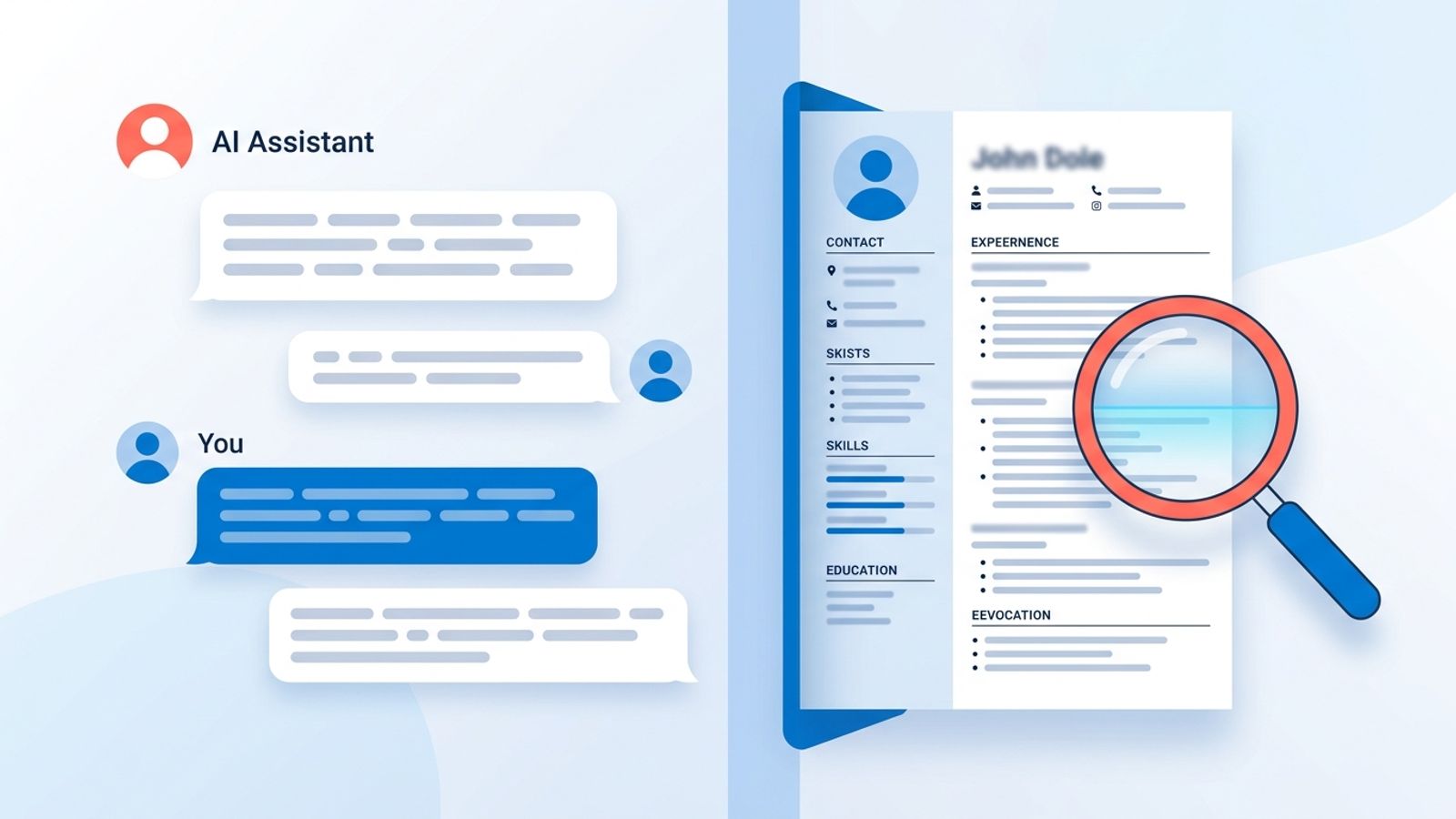
"The CV used to tell a story of effort, experience, and aptitude. Now it often tells us how well someone can prompt a large language model." That's the CEO of Willo, a hiring platform that processed 2.5 million candidate interviews in 2025. 77% of their hiring teams say they regularly encounter AI-generated applications.
The data is split down the middle. MIT Sloan studied 480,000 job seekers and found AI-assisted resumes led to 8% more hires and 8.4% higher wages. Meanwhile, 33% of hiring managers can spot AI content within 20 seconds (TopResume, 600 U.S. hiring managers). 62% reject AI resumes that lack personalization. 20% reject all AI-generated applications outright.
Using ChatGPT for your resume is not cheating. Using it badly is. The difference between "AI-assisted" (the 8% boost) and "AI-generated" (the rejection) comes down to what you keep and what you replace.
The irony: companies use AI to filter your resume, then complain when you use AI to write it. The game is rigged. Play it anyway.
Mirrai Careers
Match your resume to any job in seconds
Upload your resume, paste a job description, see your match score.
Try FreeFree month of Pro with code LAUNCH
Can You Use ChatGPT to Write a Resume?
Yes, with guardrails. The MIT Sloan experiment (480,948 job seekers, randomized trial) found that AI-assisted applicants were 8% more likely to get hired, received 7.8% more job offers, and earned 8.4% higher wages ($18.62/hr vs $17.17/hr). But the AI only helped with spelling, grammar, punctuation, and tone. It did not fabricate experience or invent metrics.
The problems start when people paste "write me a resume" into ChatGPT and submit whatever comes back. ChatGPT invents work histories, certifications, and metrics when given vague prompts (CNBC). It produces generic language that recruiters recognize instantly: "results-driven professional," "leveraged cross-functional synergies," "passionate about excellence."
37% of employers no longer view resumes as reliable talent indicators (Willo Hiring Trends 2026). 10% have replaced resumes with skills assessments. The resume is losing credibility partly because of mass AI-generated applications. 90% of hiring teams report an increase in low-effort, spammy applications (Resume Now).
“If recruiters don't want AI-written resumes then they need to stop feeding resumes through AI systems that reject every one that doesn't perfectly align with the job description.”
10 ChatGPT Prompts That Actually Work
These prompts are tested and produce usable output. Each one requires your real information as input. Never let ChatGPT invent details.
1. Professional Summary
"Act as a senior resume writer. Write a 3-sentence professional summary for a [target job title] role. My background: [X years] in [function], strengths in [top 2-3 skills]. Keep the tone direct and confident. No cliches like 'results-driven' or 'dynamic professional.'"
2. Bullet Point Rewriter
"Rewrite these resume bullets using strong action verbs and measurable results. Keep each under 20 words. Where possible, include metrics (percentages, time saved, revenue). If exact numbers are missing, suggest realistic placeholders I can fill in. My bullets: [paste]"
3. Job Description Keyword Extraction
"Extract the top 30 keywords from this job description. Categorize into Technical Skills, Soft Skills, and Industry Terms. Then identify which ones appear in my resume [paste] and which are missing."
4. Resume-JD Gap Analysis
"Compare my skills [list] with this job description [paste]. Identify what is missing or underrepresented and suggest how to incorporate those terms using my existing experience."
5. Career Transition Reframe
"I am moving from [current role] to [target role]. Rewrite my professional summary and reframe my top 5 bullet points to emphasize transferable skills. Do not fabricate experience. Only reposition what is already there. My resume: [paste]"
6. Weak Bullet Transformation (CAR Method)
"Using Challenge-Action-Result, rewrite this experience into a resume bullet: [describe situation]. Start with a strong action verb and include quantifiable impact."
7. ATS Optimization Check
"Check this resume [paste] for ATS formatting issues. Flag text boxes, tables, non-standard headers, or other elements that could break parsing. Check keyword density against this job posting [paste]."
8. Skills Section Builder
"Based on this job description [paste], identify the top 10 technical skills and top 5 soft skills to feature on my resume. Organize by relevance for ATS scanning."
9. Resume Consistency Check
"Review this resume for tense consistency, formatting issues, and repeated phrases [paste]. Flag anything that sounds generic or AI-generated. Suggest natural alternatives."
10. Cover Letter Draft
"Write a 200-word cover letter for this role [paste JD]. Reference these specific achievements from my resume: [paste 2-3 bullets]. Address it to [hiring manager name]. Do not use generic phrases like 'I am excited to apply' or 'I believe I would be a great fit.'"
Notice the pattern: you give ChatGPT real facts, it gives you better phrasing. The moment you stop feeding it your actual experience, the output turns generic.
The Detection Problem
In blind tests, 33.5% of hiring managers spotted AI-generated resumes (TopResume, 2025). Gen X and millennials caught it 34-35% of the time. Gen Z only 20%. Most detections happened in under 20 seconds. They're not analyzing your syntax. They're pattern-matching against the last 50 resumes they read.
What gives AI-written resumes away (from a 334-upvote Reddit thread and recruiter feedback):
- Excessive "leveraged," "spearheaded," "synergy," "cross-functional collaboration"
- Category labels inside bullet points ("Maintenance: Calculated inventory...")
- Too many em-dashes
- "Extreme level of hyperbole" in summaries ("Visionary thought leader with unparalleled expertise")
- Polished but empty: technically correct, reveals nothing specific about the candidate
- No real metrics anywhere. ChatGPT inserts percentages that feel round and invented
“It's not that it shows up as AI, it's that it doesn't have the information that us recruiters need.”
65% of Fortune 500 companies now use AI detection tools on applications. GPTZero offers a dedicated product for batch-scanning resumes. Getting flagged may not mean automatic rejection, but it adds a question mark that you don't want.
The 70/30 Rule
Let AI draft. Then make it yours.
| AI does (70%) | You must do (30%) |
|---|---|
| First draft of bullet points from your raw notes | Insert real metrics, numbers, dollar amounts, team sizes |
| Keyword extraction from job descriptions | Verify every claim matches your actual experience |
| Grammar, spelling, tone cleanup | Add your voice: "does this sound like how I would explain my work?" |
| Formatting consistency check | Remove AI tells: "leveraged," category labels, hyperbolic summaries |
| Multiple phrasing options to choose from | Customize for each application (not keyword-swap) |
| Translating jargon to plain language | Context only you know: team dynamics, scale, innovation |
If you're not rewriting at least a third of what ChatGPT gives you, you're sending content a recruiter has already seen 15 times today. They can tell.
“My go-to is to always write it myself first, to the best of my ability. Then put it into ChatGPT and ask to make it simple and impactful. From there, pick and choose.”
What ChatGPT Cannot Do
- Know your actual achievements. It generates plausible-sounding bullets that may not reflect what you did.
- Add real metrics. Without your numbers, it substitutes vague language or invents percentages.
- Match ATS formatting. ChatGPT output needs to be placed into a properly formatted document.
- Understand your target company. "I admire [Company]'s commitment to innovation" is generic. Specific company knowledge requires your research.
- Maintain your professional voice. AI has a detectable "tone" that experienced recruiters recognize.
- Verify facts. It will confidently list certifications you don't have if you don't catch it.
ChatGPT makes writing faster. It doesn't make thinking optional. Your real experience, your real numbers, your actual understanding of what the employer needs — that's still on you.
Want resume tailoring without the prompt engineering? Mirrai analyzes your actual resume against the job description, scores the match, and shows exactly what to change. It works from your real data, not generated text.
Before you leave
See how your resume stacks up
Paste any job description and get your match score in 30 seconds.
Try FreeFree month of Pro with code LAUNCH
FAQ
Will I get caught using ChatGPT for my resume?
Is it unethical to use AI for resume writing?
Which ChatGPT model works best for resumes?
Should I use ChatGPT or a dedicated resume tool?
How do I make AI-written content sound human?
Build a resume from your real experience, matched to any job description. Try Mirrai's Resume Builder. It works from your actual data, not prompts.