Mirrai Careers
Cover Letter vs Resume: What's the Difference? (2026)
A resume lists what you have done. A cover letter explains why it matters for this specific job. You usually need both. Here is when each one counts and when you can skip.

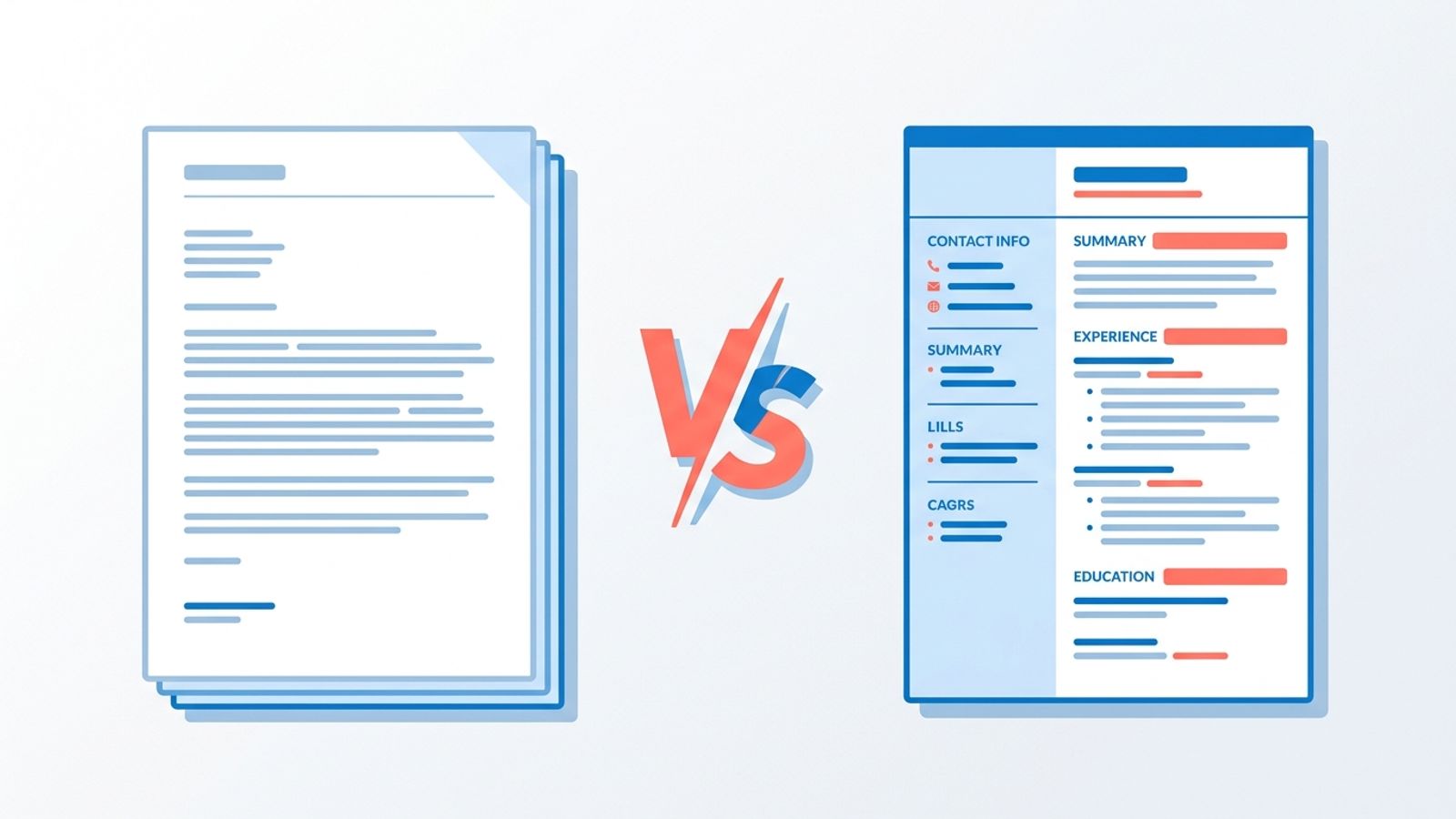
A resume gets you through ATS. A cover letter gets you past the 7-second recruiter scan with context your resume cannot provide. They do different jobs, and confusing them (or skipping one when you should not) costs interviews.
Short version: your resume is what you've done. Your cover letter is why it matters here. One lists qualifications. The other connects them to a specific role at a specific company.
Mirrai Careers
Match your resume to any job in seconds
Upload your resume, paste a job description, see your match score.
Try FreeFree month of Pro with code LAUNCH
Cover Letter vs Resume: Quick Comparison
| Resume | Cover Letter | |
|---|---|---|
| Purpose | Lists qualifications, experience, skills | Explains why you fit this specific role |
| Format | Structured: sections, bullets, keywords | Narrative: paragraphs, story, persuasion |
| Length | 1-2 pages (475-600 words optimal) | 250-400 words (one page max) |
| Tailoring | Keywords matched to job description | Content written for this company specifically |
| ATS impact | High: ATS parses and ranks by keywords | Lower: not all ATS scan cover letters |
| Recruiter time | 7.4 seconds initial scan (Ladders) | 36% spend under 30 seconds, 60% spend up to 2 minutes |
| Required? | Always | Usually: 83% of hiring managers read them even when optional |
| What it proves | You have the qualifications | You understand the role and want this job specifically |
What a Resume Does
A resume is a structured document that answers one question: what have you done? It lists your work experience, education, skills, and certifications in a format ATS can parse and recruiters can scan in seconds.
97.8% of Fortune 500 companies filter resumes through ATS (Jobscan 2025). Tailored resumes get 11.7% callback versus 4.2% for generic ones (CoverSentry, 15,000 applications). The resume determines whether you make it into the "maybe" pile.
What a resume cannot do: explain why you are changing careers, provide context for an employment gap, show personality, or demonstrate specific interest in the company. It is a data sheet, not a conversation.
The resume gets you into the pile. The cover letter is why someone picks yours up. One without the other is half an application.
Full guide: How to Make a Resume That Gets Interviews.
What a Cover Letter Does
A cover letter is a one-page narrative that answers a different question: why should we hire you for this specific role? It bridges the gap between your resume (what you did) and the job (what they need).
Tailored cover letters get 16.4% callback versus 10.7% with no letter (ResumeGo, 6,000+ applications). 94% of hiring managers say cover letters influence their interview decisions. 49% say a strong letter has secured interviews for candidates with otherwise weak resumes.
What a cover letter cannot do: replace a resume. No structured data for ATS. No skills section for keyword matching. No chronological work history for verification. It adds to the resume. It doesn't replace it.
Full guide: How to Write a Cover Letter With Templates.
Do You Need Both?
For most applications, yes. But the effort allocation should be uneven:
| Situation | Resume | Cover Letter |
|---|---|---|
| Online portal (LinkedIn, Indeed) | Required, tailored to keywords | Include if upload field exists. Skip if no option to attach. |
| Direct email to hiring manager | Attached as PDF | The email body IS the cover letter. Most important part. |
| Referral | Required for the person forwarding it | Short note explaining connection and fit |
| Career change | Required, skills-first format | Critical: explains why your background matters for the new field |
| Entry-level | Required, education + projects focused | Helps: 67% higher callback at entry level (multiple sources) |
| Mass applying (50+ jobs/week) | Tailored to each role | Skip for most. Write for the 5-10 you actually want. |
83% of hiring managers read cover letters even when they are listed as optional. "Optional" means "we will read it if you send one." For roles you actually want, include both. For volume applications, the resume alone carries the weight.
Which One Matters More?
The resume. It is the document ATS processes. It is what 88% of hiring managers call the most important section of an application. Without a strong resume, no cover letter saves you.
But "more important" does not mean "the only one that matters." A tailored cover letter adds 5.7 percentage points to your callback rate over no letter (16.4% vs 10.7%, ResumeGo). At scale, that is the difference between 5 callbacks and 8 callbacks per 50 applications. Three extra shots at an interview, from a 20-minute investment per application.
Build both with the right content. Resume Builder for your resume. Cover Letter Generator for the letter. Both tailored to the job description.
Before you leave
See how your resume stacks up
Paste any job description and get your match score in 30 seconds.
Try FreeFree month of Pro with code LAUNCH