Mirrai Careers
How to Make a Resume That Actually Gets Interviews (2026)
97% of resumes don't lead to an interview. Most guides teach you to make a pretty resume. This one teaches you to make one that works.

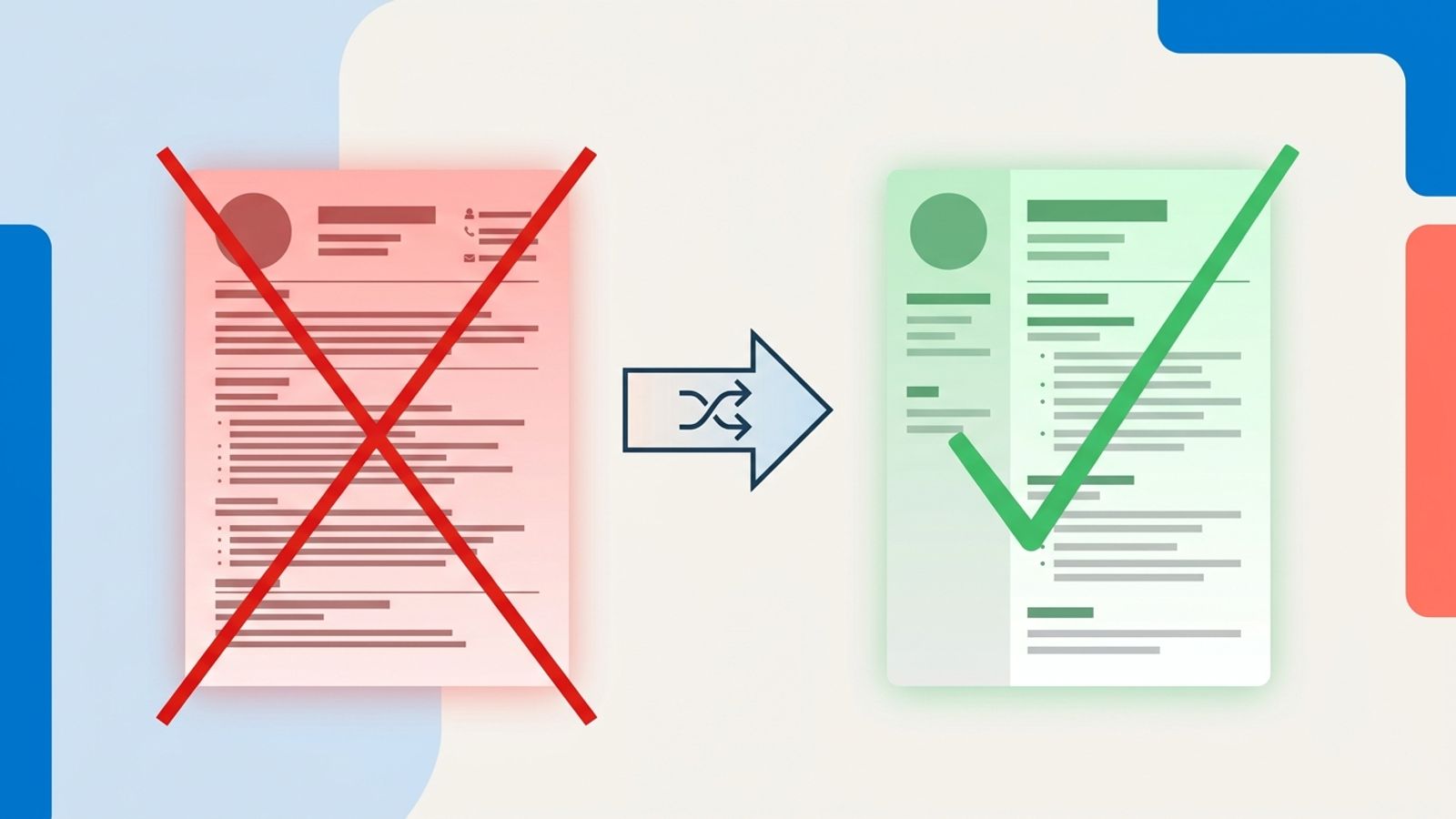
The average job posting gets 340 applicants (Ashby, 2025). Of those, 75% are rejected by ATS before a human sees them (Gitnux). Of the ones that get through, recruiters spend 7.4 seconds deciding whether to keep reading (Ladders Eye-Tracking Study). At the end of the funnel, 2-3% of applicants get an interview.
Those numbers are not a reason to panic. They are the game. Your resume is a filter, not a formality. Most guides teach you how to make a pretty document. This one focuses on what actually moves the needle.
Nobody teaches you this in school. Four years of college and not one class on how to get past a robot that reads your resume in 6 seconds.
Mirrai Careers
Match your resume to any job in seconds
Upload your resume, paste a job description, see your match score.
Try FreeFree month of Pro with code LAUNCH
Start With the Job Description, Not a Template
54% of candidates don't tailor their resume to each application (Marketsplash). They write one document and blast it everywhere. Tailored applications get 78% higher response rates (Wellfound). That gap is the entire difference between callbacks and silence.
Before you type a single word, read the job description. Highlight the skills, tools, and qualifications mentioned. These are the keywords ATS will scan for, and the priorities the recruiter will skim for in those 7.4 seconds.
ATS-optimized resumes get a 11.7% callback rate versus 4.2% for generic ones (Scale.jobs, study of 15,000 applications). Nearly 3x the difference, from the same person with the same experience.
“Use a gmail email address and delete your hotmail. Don't put an objective section or summary as it will be skipped. References should not be on the resume; they should only be provided once asked for.”
Pick the Right Format
Three formats exist. Only one works for most people.
Reverse-chronological (most recent job first): this is what 90%+ of recruiters expect and what ATS parses best. Use this unless you have a specific reason not to.
Hybrid/combination (skills section + chronological experience): works for career changers who need to lead with transferable skills. 43% of hiring managers prefer this for mid-career professionals (ResumeGenius).
Functional (skills-only, no timeline): raises suspicion. Recruiters assume you're hiding gaps or short tenures. Avoid unless a career coach specifically recommends it for your situation.
Resume Length: The Data Says Two Pages
The one-page rule is dead. ResumeGo studied thousands of resumes and the data is not close:
- Recruiters are 2.3x more likely to prefer two-page resumes
- 68.3% of hiring managers consider two pages ideal
- Two-page resumes scored 21% higher on average (8.6 vs 7.1)
- At the managerial level, the preference jumps to 2.9x
One page works if you have under 5 years of experience. Beyond that, cutting relevant experience to fit one page hurts you more than the extra page does.
The ceiling: resumes over 600 words are 43% less likely to result in hiring (Ladders). So two pages of substance, not two pages of filler.
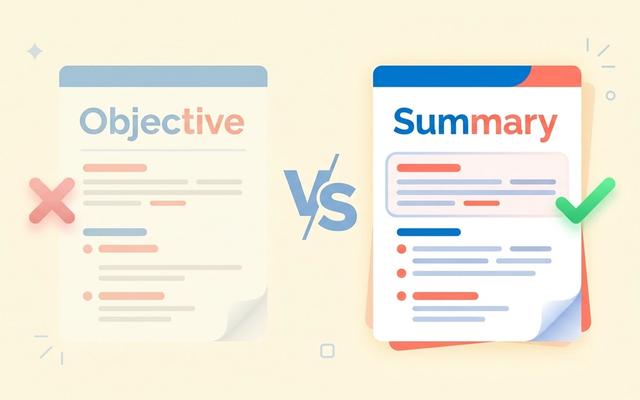
Write a Summary, Not an Objective
Resumes with professional summaries get 340% more interview callbacks than those with objectives (The Interview Guys). Only 40% of resumes include a summary at all (Enhancv). The optimal length is 47-57 words.
| Before (objective) | After (summary) | |
|---|---|---|
| What it says | Results-driven sales professional with 8 years of experience. Looking to move into a management role where I can lead a team and drive revenue growth. | Top-performing sales executive who exceeded quota by 135% for 12 consecutive quarters, generating $3.8M annually. Mentored 5 junior reps who improved performance by 40%. President's Club award 3 years running. |
| What recruiter sees | What you want from them | What you've already proven |
“Be precise with details, describe impact not just achievements, use one page max, ensure 10-second comprehension, use bullet points, explain employment gaps upfront, remove references and objective summaries.”
Write Bullet Points That Prove Something
"Responsible for customer service" tells a recruiter nothing. How many customers? What was the outcome? What changed because you were there?
The formula: Action verb + what you did + how you measured it + result
| Before | After |
|---|---|
| Responsible for customer service | Resolved 90+ daily client inquiries via Zendesk, maintaining 98% satisfaction rating |
| Helped with marketing campaigns | Designed 5 email campaigns increasing click-through by 27%, generating $50K in new business |
| Improved sales | Grew Midwest territory revenue 18% YoY through CRM pipeline optimization |
| Managed website content | Increased qualified leads 42% in 6 months via 15+ optimized landing pages |
| Helped students improve scores | Developed curriculum resulting in 4.3 AP average and 92% success rate |
Quantified achievements increase callback rates by 40% (multiple sources). If you can't find a number, estimate. "Managed a team" becomes "Managed a team of 6." Approximate is better than vague.
“I was instructed to reword my bullet points by adding numbers and beginning with powerful action verbs. After a week, I had three callbacks instead of zero.”
The Skills Section: Specific Beats Generic
Your skills section is what ATS scans first. 75% of resumes are rejected because they lack specific hard skills the job requires. "Communication" and "teamwork" won't trigger any ATS filter. "Python," "Salesforce," and "Agile/Scrum" will.
| Before (vague) | After (specific, categorized) |
|---|---|
| Skills: Communication, Microsoft Office, teamwork, leadership, problem solving, detail-oriented | Technical: Python, JavaScript (React/Node.js), SQL, Tableau, Git | Project Management: Agile/Scrum, Jira, Confluence | Analytics: Google Analytics 4, A/B testing, CRM (Salesforce, HubSpot) |
Group by category. Name specific tools. Drop "detail-oriented" and "team player." Every applicant claims those, and ATS literally cannot score them. 88% of hiring managers focus on hard skills (Glassdoor).
“Use straightforward, unambiguous headers such as "Education," "Work Experience," and "Skills." ATS systems are programmed to recognize standard section names, not "My Career Journey" or "What I Bring to the Table."”
Format for ATS, Not for Instagram
68% of hiring managers reject poorly formatted resumes (Qureos). But what ATS considers "good formatting" and what looks good on Dribbble are completely different.
What works:
- Single-column layout (multi-column confuses ATS parsers)
- Standard fonts (Arial, Calibri, 10-12pt)
- Section headers matching ATS expectations: "Work Experience" not "My Professional Journey"
- Bullet points, not paragraphs
- PDF or .docx (created from text, not a scanned image)
- File named "FirstName_LastName_Resume.pdf"
What kills your resume:
- Graphics, charts, or skill rating bars (ATS can't read images)
- Text in headers or footers (most ATS skip these entirely)
- Creative fonts, colored backgrounds, icons
- Photos or headshots (88% rejection rate in the US, per TeamStage)
- Two-column layouts (many ATS read left column only)
“I received more interviews with a simple, one-column resume template I discovered on r/resumes than with my sophisticated Canva one.”
The Uncomfortable Truth About Brand Names
An interviewing.io study of 76 recruiters found something that most resume guides won't tell you: recruiters prioritize recognizable company names and school brands above almost everything else.
Their experiment: a resume with obviously fabricated, absurd achievements still got a 90% callback rate because it listed FAANG employers. In another test, simply moving a recognizable employer from the bottom to the top of a resume (no rewording, just repositioning) increased interview invitations by 8x.
This doesn't mean your resume is hopeless without Google on it. It means: put your strongest, most recognizable experience at the top. If you worked at a well-known company even briefly, lead with it. If your education is your strongest brand signal, put it high. The order matters more than most people think.
Handle Employment Gaps Without Apologizing
Unexplained gaps reduce callback chances by 15% (Nature). But the fix is framing, not hiding.
| Before (draws attention to gap) | After (shows growth during gap) |
|---|---|
| Marketing professional currently looking to return to the workforce after taking time off for family reasons. Eager to apply my skills. | Brand marketing strategist with 7+ years driving double-digit growth for consumer products. Recently completed Google Digital Marketing certification while managing freelance projects that increased client conversion rates by 23%. |
The gap still exists. But the narrative shifted from "I stopped working" to "I kept growing." Show what you did during the gap: freelance work, certifications, courses, volunteer projects.
“First you get the date, then you tell them you're divorced. Meaning: get the interview first. Explain gaps in person where you can add context.”
The Networking Reality
One more uncomfortable truth. 70% of jobs are never published on job boards (CNBC). 40% of new hires come from employee referrals (Zippia), even though referrals represent only 7% of the candidate pool. Having a LinkedIn profile on your resume increases interview chances by 71% (ResumeGo).
Your resume gets you through ATS. But a referral gets you past ATS entirely. If you can get someone at the company to forward your resume internally, your odds jump from 2-3% to 40%+.
This doesn't make resume optimization pointless. You still need a strong resume for the referral to forward. But spending 100% of your time perfecting a resume and 0% networking is a losing strategy.
Networking covers the 70% that never gets posted. For the roles that do get posted, skip the aggregator boards and read company career pages directly, where the listing is fresher and you're not fighting 300 other people who saw the same repost. A search that does that across a lot of companies at once and ranks the results against your resume turns the published slice into a short, high-fit list instead of an endless feed. Mirrai's AI Job Search works this way, pulling roles straight from career pages and flagging the stale and ghost ones.
Ready to check how your resume stacks up? See your ATS match score in 30 seconds. Paste any job description and find out what's missing.
Before you leave
See how your resume stacks up
Paste any job description and get your match score in 30 seconds.
Try FreeFree month of Pro with code LAUNCH
FAQ
How long should my resume be?
Should I use AI to write my resume?
Do I need a different resume for every job?
What about cover letters?
My resume looks great but I'm getting no callbacks. What's wrong?
Where should I look for jobs beyond the big job boards?
Build your resume with the right format, keywords, and structure. Try Mirrai's free AI Resume Builder. It handles ATS formatting automatically.
Once your resume is ready, tailor it for each application. Our guide on how to tailor your resume to a job description walks through the process step by step. And when you land the interview, here are the questions they'll ask.