Mirrai Careers
Resume Summary Examples: 25+ Samples That Get Interviews (2026)
Resumes with a summary get 36% more callbacks. Yet 60% of people skip it. Here are 25+ examples by profession, with breakdowns of why each one works.


Resumes with a tailored professional summary get 36% more callbacks than those with a generic objective (TopResume, 2024). 83% of recruiters prefer summaries over objectives (CareerBuilder). Yet 60% of resumes either skip the summary entirely or fill it with buzzwords like "passionate team player" that could describe anyone on the planet.
Which is wild, considering it takes 3 sentences.
Your summary sits in the F-pattern scan zone where recruiters spend the first 2-3 seconds of their 7-second review (Ladders eye-tracking study). It's the one section most recruiters actually read word-for-word. Everything else gets skimmed.
Below: 25+ examples by profession, breakdowns of why each works, 6 examples of what not to do, and the data behind all of it.
Mirrai Careers
Match your resume to any job in seconds
Upload your resume, paste a job description, see your match score.
Try FreeFree month of Pro with code LAUNCH
What Is a Resume Summary
A resume summary is 3-4 sentences at the top of your resume that answer three questions: what do you do, what have you achieved, and what value do you bring. Optimal length: 40-60 words. Eye-tracking data shows recruiter attention drops sharply after line 3.
58% of recruiters auto-reject resumes with generic summaries that don't match the job posting (Recruiter.com). 76% of resumes contain buzzwords like "hard-working" and "results-driven" in the summary (Talent Inc., analysis of 6,000 resumes). "Passionate" alone appears in 34% of summaries (LinkedIn data).
If your summary could be copy-pasted onto any resume in any industry and still make sense, it's not doing its job.
“The summary is the ONE thing I actually read word-for-word. Everything else I scan. If your summary doesn't tell me what you do and why you're good at it in 2-3 lines, I'm already forming a negative impression.”
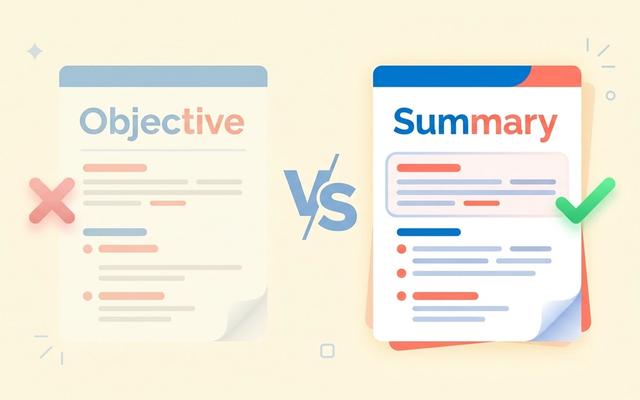
Resume Summary vs Objective: Use a Summary
Objective statements ("Seeking a position where I can grow...") are considered outdated by 95% of career professionals surveyed by SHRM. The difference is simple: objectives tell the employer what you want from them. Summaries tell the employer what you've done for others like them.
| Objective | Summary | |
|---|---|---|
| Focus | What you want | What you offer |
| Tone | Self-centered | Value-centered |
| Recruiter preference | 17% | 83% (CareerBuilder) |
| Callback impact | Baseline | +36% (TopResume) |
| When to use | Almost never | Almost always |
The one exception: complete career changers who need to explicitly state what role they're targeting, since their experience won't make it obvious. Even then, frame it as a summary with a transition statement, not a traditional objective.
“Drop the objective statement. Nobody cares what YOU want from the job. They care what you bring to THEM. A summary should answer: what's your expertise, what's your biggest achievement, and what value do you add. That's it.”
How to Write a Professional Summary for Your Resume
The formula: [Title/expertise] + [years of experience] + [1-2 key achievements with numbers] + [relevant skills or certifications]. Keep it under 60 words.
Three rules:
- Every sentence should contain either a number or a named skill. No filler.
- Match the language from the job description. If they say "cross-functional collaboration," use that phrase. 40% better ATS pass rate for keyword-matched summaries (Jobscan).
- Write in implied third person. Not "I managed a team" but "Managed a team of 12." 65% of recruiters prefer this voice (ZipRecruiter).
Tailor it for each application. Yes, every time. Candidates who customize their summary get 2.5x more interviews than those who don't (Indeed Hiring Lab).
“Changed my summary from generic buzzwords to specific metrics and got 3x more callbacks in the same month. Old: 'Passionate marketing professional seeking growth opportunities.' New: 'Digital marketing manager with 6 years driving B2B lead gen — grew SQLs 140% and cut CAC 35% at a Series B SaaS.' Night and day.”
25+ Resume Summary Examples by Profession
Each example is 40-60 words with an analysis of why it works.
Software Engineer (Junior)
"Full-stack developer with 2 years building responsive web applications in React, Node.js, and PostgreSQL. Shipped 12 production features at a Series A startup, reducing page load times by 40%. Strong debugging skills and CI/CD proficiency."
Why it works: names the exact tech stack, quantifies output (12 features, 40% improvement), and signals startup adaptability.
Software Engineer (Senior)
"Senior software engineer with 9 years architecting scalable distributed systems processing 2M+ daily transactions. Led a 6-person backend team at a fintech company, reducing API latency 60% and system downtime by 85%. Expertise in Go, Kubernetes, and event-driven architectures."
Transaction volume signals scale. Leadership and mentoring show senior-level scope beyond writing code.
Marketing Manager
"Data-driven marketing manager with 7 years leading B2B demand generation across SaaS and fintech. Grew marketing-qualified leads 180% year-over-year while reducing cost per acquisition by 32%. HubSpot and Marketo certified."
Why it works: two hard metrics (180% MQL growth, 32% CAC reduction), named certifications, addresses marketing-sales alignment.
Registered Nurse
"Registered nurse (BSN, RN) with 5 years in high-acuity ICU and cardiac step-down units. Maintained 98% patient satisfaction while managing caseloads of 6-8 critically ill patients per shift. ACLS and PALS certified with EHR expertise."
Why it works: credentials first (BSN, RN), patient load quantified, certifications are non-negotiable in healthcare.
Teacher
"State-certified elementary educator with 6 years raising standardized test scores by 22% across diverse Title I classrooms. Skilled in differentiated instruction, IEP implementation, and educational technology. Teacher of the Year, Lincoln Elementary, 2025."
Test score improvement is the metric principals actually care about. Title I experience signals you've worked with underserved populations, not just suburban honors classes.
Project Manager
"PMP-certified project manager with 8 years delivering complex IT projects on time and under budget. Managed portfolios valued at $4.5M+ across Agile and Waterfall, maintaining 95% on-time delivery. Skilled in stakeholder management and risk mitigation."
Why it works: PMP up front (table-stakes), dollar value signals scope, 95% on-time is a concrete KPI.
Data Analyst
"Data analyst with 4 years transforming raw datasets into actionable intelligence using SQL, Python, and Tableau. Built automated dashboards saving 15 hours/week and identified $1.2M in revenue leakage through churn analysis. Strong executive-level presentation skills."
Why it works: tool stack named, time saved and revenue impact quantified, soft skill tied to a real need.
Sales / Account Executive
"B2B account executive with 5 years exceeding quota by 120-135% in enterprise SaaS sales. Closed $3.8M in ARR across mid-market and enterprise accounts with a 45-day average sales cycle. 40% repeat business through consultative selling."
Why it works: quota attainment is the single most important metric in sales hiring. ARR and repeat business reinforce the narrative.
Customer Service
"Customer service professional with 3 years maintaining 96% satisfaction while handling 80+ daily interactions across phone, email, and live chat. 92% first-contact resolution rate, consistently top 5% of the support team. Zendesk and Intercom experienced."
Why it works: high volume (80+/day) shows efficiency. CSAT and FCR are the KPIs hiring managers filter for.
Career Changer (Hospitality to Corporate)
"Operations professional transitioning from 8 years of high-volume hospitality management into corporate project coordination. Managed teams of 25+, coordinated events generating $500K+ in revenue, and reduced vendor costs by 18%. Proven skills in stakeholder communication and deadline management."
Hospitality reframed in corporate language without hiding the transition. Reads like a deliberate career move, not a desperate pivot.
“For career changers: your summary is the MOST important section. It's the bridge between your old career and your new one. Don't just list transferable skills — frame your transition as a deliberate evolution, not a desperate pivot.”
Career Changer (Military to Civilian)
"Logistics leader transitioning from 10 years of U.S. Army service into supply chain management. Directed transportation operations for 200+ personnel and $12M in equipment across 3 deployments. Secret clearance with expertise in inventory management and risk assessment."
Why it works: military jargon translated to civilian equivalents. Security clearance is a real differentiator.
Entry-Level (Business Graduate)
"Recent BBA graduate from the University of Michigan with concentrations in finance and data analytics. Completed a 6-month investment banking internship, building financial models supporting $15M in M&A advisory. Proficient in Excel (advanced modeling), Bloomberg Terminal, and Python."
Why it works: names school and concentration, quantifies internship impact, lists specific tools.
“Entry-level candidates: you CAN write a summary even without experience. Lead with your degree, mention a relevant project or internship, and state what you're looking to contribute.”
Entry-Level (Liberal Arts Graduate)
"Communications graduate with hands-on experience managing social media accounts that grew engagement 65% during a nonprofit internship. Published 20+ articles in the university newspaper covering local government. Strong research, writing, and audience analysis skills."
Why it works: turns "soft" experience into measurable results (65% growth, 20+ articles).
Executive / VP
"VP of Operations with 15 years scaling mid-market companies through rapid growth, M&A integration, and digital transformation. Led a 120-person division, driving $28M in annual cost savings through process automation. Board-level communicator with leadership teams across 4 countries."
Executive scope: $28M, 120 people, 4 countries. The strategic language signals C-suite readiness without using the word "visionary."
Administrative Assistant
"Administrative professional with 4 years supporting C-suite executives in fast-paced tech companies. Managed complex calendars across 3 time zones, coordinated 50+ quarterly events, and reduced office supply costs by 22% through vendor renegotiation. Proficient in Microsoft 365 and SAP Concur."
Why it works: specificity (3 time zones, 50+ events, 22% savings) elevates beyond the generic admin summary.
Graphic Designer
"Visual designer with 5 years creating brand identities and digital experiences for B2C e-commerce brands. Redesigned a product page UI increasing conversions 28% and reducing bounce rates 15%. Expert in Figma, Adobe Creative Suite, and motion graphics. Portfolio of 40+ shipped projects."
Why it works: conversion and bounce rate data prove design decisions drive business outcomes.
Finance / Accounting
"CPA-licensed accountant with 6 years in financial reporting, audit, and regulatory compliance for publicly traded companies. Led SOX compliance across 3 business units and reduced month-end close from 12 days to 7. Proficient in SAP, Oracle NetSuite, and advanced Excel."
Why it works: CPA up front, SOX signals public-company experience, close-cycle improvement is a CFO metric.
Human Resources
"SHRM-CP certified HR generalist with 5 years managing full-cycle recruitment, employee relations, and benefits for organizations of 200-500 employees. Reduced time-to-fill by 35% through ATS optimization while maintaining 91% retention. Experienced in Workday and BambooHR."
Why it works: time-to-fill and retention are the two metrics HR directors measure most.
Product Manager
"Product manager with 6 years leading B2B SaaS products from discovery through launch, driving $4.2M in incremental ARR. Managed cross-functional teams of 8-12 across engineering, design, and data to ship 15+ features with 94% on-time delivery. Skilled in Agile and data-informed roadmap prioritization."
ARR is the metric that gets PMs hired. Cross-functional team size and 15+ shipped features prove you execute, not just roadmap.
Cybersecurity Analyst
"Security analyst with 4 years protecting enterprise networks in healthcare and financial services. Contained 150+ incidents with zero data breaches, reducing mean time to response by 60% through SOAR automation. CISSP and CompTIA Security+ certified."
Why it works: zero breaches is the ultimate cybersecurity KPI. Certifications are hard requirements.
Resume Summary Mistakes: 6 Examples of What Not to Do
The Buzzword Salad
"Dynamic, results-oriented professional with excellent communication skills and a proven track record of success. Passionate team player who thrives in fast-paced environments and consistently delivers exceptional results."
Every phrase is filler. "Results-oriented" with no results. "Proven track record" with no proof. Swap this summary onto any resume in any industry and nobody would notice.
“The worst summaries I see are the ones that could apply to literally anyone. 'Hard-working team player with excellent communication skills' tells me absolutely nothing. Replace every adjective with evidence.”
The Novel (97 words)
"Highly motivated marketing professional with over 8 years of comprehensive experience in developing, implementing, and managing complex multi-channel marketing campaigns across digital and traditional media platforms including social media, email, content marketing, SEO, PPC, display, affiliate, and influencer partnerships..."
That's 97 words. Double the optimal length. The channel list reads like someone dumped every marketing keyword they could think of. By sentence three, the recruiter has already moved on.
The Self-Focused Objective
"Seeking a position in software development where I can use my programming skills and grow my career in a supportive environment that values work-life balance."
Every clause is about what the candidate wants. Hiring managers don't care about your desire for work-life balance at the resume stage. This tells them nothing about your value.
The Copy-Paste Generic
"Experienced professional with a background in various industries. Skilled in Microsoft Office, communication, and time management. Looking for a new opportunity to contribute to a growing organization."
"Various industries" means no expertise anywhere. "Microsoft Office" is assumed. This summary qualifies for no specific role.
The Humble Bragger
"Visionary thought leader and industry disruptor with unparalleled expertise in transforming organizations. Known for groundbreaking strategies that revolutionize business outcomes."
Grandiose language with zero evidence. "Visionary thought leader" is a claim, not a credential. This would likely be mocked internally.
The Oversharer
"Hard-working mother of three who took 5 years off to raise my family and is now ready to re-enter the workforce. I'm a fast learner despite being away from the corporate world."
Family status and gap framing as a deficit invite unconscious bias. Show growth during the gap instead of apologizing for it.
“I've been in HR 12 years. The summaries that make me keep reading have numbers in them. Revenue generated, team size managed, percentage improvements. If I see a summary with zero quantifiable results, I assume the candidate doesn't track their impact.”
Before you leave
See how your resume stacks up
Paste any job description and get your match score in 30 seconds.
Try FreeFree month of Pro with code LAUNCH
FAQ
How long should a resume summary be?
Should entry-level candidates write a summary?
Should I use first person ('I managed') or third person?
Do I need a different summary for every application?
What if I have no metrics to include?
Build your resume with a summary that matches the job. Try Mirrai's free AI Resume Builder. It tailors your summary to any job description automatically.
Your resume summary and your "tell me about yourself" interview answer should tell the same story. If you're tailoring your resume per application, your summary should change too: how to tailor your resume to a job description.