Mirrai Careers
Skills to Put on a Resume: 100+ by Role + How to Choose (2026)
76% of recruiters start their search with skills. Most resumes miss 52% of job-description keywords. Hard, soft, and AI skills by role, plus the 8-12 sweet spot.

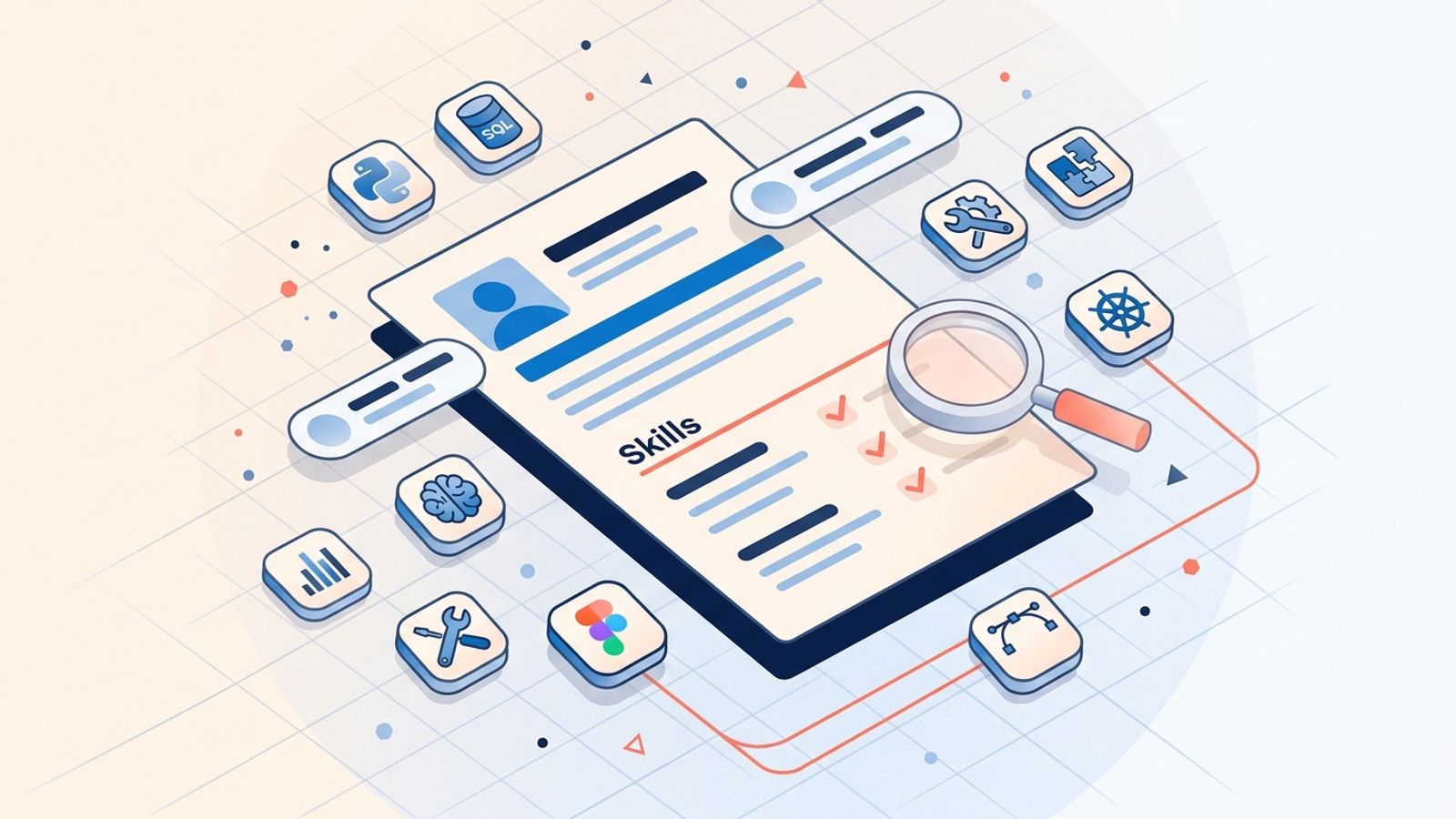
76.4% of recruiters start their search with skills (LockedIn AI, 2025). Not job title, not company name. Skills. If the right ones are not on your resume, the ATS does not surface you and a human never sees the page.
The average unoptimized resume is missing 52% of the keywords in its target job description (Resume Optimizer Pro, 12,000+ optimization runs). Resumes that close that gap go from a 47% pre-optimization ATS match to 81% after a single rewrite. Same person, same experience. Different word choices.
Below: which skills to put on a resume in 2026, the ratio of hard to soft, the AI category employers now expect, the 8-12 sweet spot, and how to mirror the job description without sounding like a robot.
Mirrai Careers
Match your resume to any job in seconds
Upload your resume, paste a job description, see your match score.
Try FreeFree month of Pro with code LAUNCH
What Skills to Put on a Resume in 2026
Three buckets, in this order of ATS weight: hard skills (technical tools and methods), AI skills (which used to be a sub-category and now stand on their own), and soft skills (proven through achievements, not listed as adjectives).
70% of employers now use skill-based hiring, up from 65% the prior year (NACE Job Outlook 2026). 71% use it at least half the time. The shift means your skills section is no longer a footnote at the bottom of the page; it is one of the first things both the bot and the recruiter check.
“Skills sections that list everything you have ever touched. If it is on the resume, you should be able to talk about it confidently in an interview. Remove anything you would hesitate to be quizzed on.”
Hard Skills vs Soft Skills: What ATS Actually Reads
Hard skills carry 2-3x more weight than soft skills in ATS keyword matching. "Python," "SQL," "Kubernetes" are scored. "Team player," "detail-oriented," "results-driven" are largely ignored. The reason is mechanical: hard skills are nouns that map cleanly to a job posting; soft skills are adjectives that map to nothing.
| Type | What it is | ATS weight | Where to show it |
|---|---|---|---|
| Hard skills | Specific, measurable, learnable (Python, SEO, Excel, AWS) | High; direct keyword match | Skills section + bullets |
| Soft skills | Behavioral patterns (communication, problem-solving) | Low; semantic not literal | Proven in bullets, not listed |
| AI skills | AI tools and prompt fluency (ChatGPT, Copilot, Notion AI) | High and rising; 70% employers now ask | Skills section + bullets |
The practical implication: put your concrete hard skills in the skills section, mention AI tools you actually use, and prove soft skills through your achievement bullets instead of listing them as bare adjectives. A bullet that says "Mediated a customer escalation that recovered a $40K account" demonstrates communication and problem-solving without ever using either word.
Top Hard Skills by Role in 2026
Skills employers actually search for, by job family. List the ones you can talk about confidently in an interview. Leave off the ones you used once in 2018.
| Role | Top 8 hard skills |
|---|---|
| Software Engineer | Python, JavaScript/TypeScript, SQL, Git, Docker, Kubernetes, React, AWS |
| Data Analyst / Scientist | SQL, Python (pandas, scikit-learn), Tableau, Power BI, Excel (advanced), R, A/B testing, dbt |
| Product Manager | JIRA, Figma, SQL (basic), Mixpanel/Amplitude, roadmap planning, A/B testing, OKRs, Notion |
| Marketing Manager | Google Analytics, HubSpot/Marketo, SEO, SQL (basic), Tableau, Mailchimp, content strategy, Meta Ads |
| Designer (UX/UI) | Figma, Sketch, Adobe XD, prototyping, user research, design systems, accessibility (WCAG), Notion |
| Sales / Account Exec | Salesforce, Outreach/Apollo, LinkedIn Sales Navigator, MEDDIC, forecasting, ZoomInfo, contract negotiation |
| Finance / Analyst | Excel (advanced), SQL, Tableau/Power BI, financial modeling, FP&A, NetSuite/Oracle, GAAP |
| Operations Manager | Excel, SQL, process mapping (Lucidchart), Six Sigma, supply-chain analytics, NetSuite, Lean |
| Recruiter / TA | LinkedIn Recruiter, ATS platforms (Greenhouse, Lever, Workday), Boolean search, employer branding |
| Customer Success | Gainsight/Totango, Zendesk/Intercom, SQL (basic), Salesforce, NPS analysis, onboarding playbooks |
How to pick from each list: open the job description for your target role, find the 8-12 skills it mentions, and put the ones you genuinely know on your resume. Do not add the ones you do not. The interview question that follows ("walk me through how you used Kubernetes last quarter") makes guessing painful.
Want to know which keywords a specific job posting expects from your resume? Paste any JD into our Job Matcher and see which skills you are missing in 30 seconds.
Top Soft Skills That Hiring Managers Actually Care About
When NACE surveyed employers about what they look for in resumes for the Class of 2026, four soft skills came up across more than half of respondents:
- Problem-solving (89% of employers)
- Teamwork (78%)
- Written communication (70%+)
- Analytical / quantitative skills (close behind communication)
Other soft skills that hold up across industries: adaptability, ownership, time management, decision-making, stakeholder management, and conflict resolution. These are the ones recruiters notice when they show up in your bullets. Listed as adjectives in a skills section, they say nothing.
Don't list these as bare adjectives
Team player. Hard worker. Results-oriented. Detail-oriented. Self-starter. Passionate. Driven. Strong communicator. These describe 100% of applicants. ATS scores them as noise. Recruiters skip past them. Prove the underlying skill in your bullets instead.
The fix: turn each soft skill into evidence. Instead of "strong communicator," write "Authored a quarterly stakeholder report read by 4 VPs and 12 directors." Instead of "team player," write "Coordinated a cross-functional launch with engineering, design, and ops, shipping the feature 2 weeks ahead of schedule." Now the skill is provable.
A separate guide to action verbs covers the verb library that pairs with skills, with 200+ verbs by category.
AI Skills: The New Category for 2026
70% of employers now evaluate AI fluency during interviews, even when it is not listed in the job description (LockedIn AI 2026 survey). The skills section is where you signal this before the interview happens.
Three rules for the AI sub-section of your skills:
- Name specific tools, not "AI" as a generic. "ChatGPT, Claude, GitHub Copilot, Notion AI" tells a recruiter you have actually used them. "AI" by itself tells them nothing.
- Match the tool to the role. Designers list Figma AI and Adobe Firefly. Engineers list Cursor and Copilot. Writers list ChatGPT and Claude. Listing tools your role does not touch reads as filler.
- Add prompt fluency as a separate skill if the role is knowledge-work. "Prompt engineering for [tool]" or "AI-assisted [your discipline]" signals you have moved past the dabbling stage.
| Role | AI skills that fit |
|---|---|
| Software Engineer | GitHub Copilot, Cursor, Claude Code, AI code review, prompt engineering for code generation |
| Designer | Figma AI, Adobe Firefly, Midjourney, AI-assisted user research, prompt engineering for design |
| Writer / Marketer | ChatGPT, Claude, Jasper, AI-assisted SEO research, prompt engineering for content |
| Analyst / PM | ChatGPT, Claude, Notion AI, AI-assisted SQL, prompt engineering for analysis |
| Recruiter / HR | LinkedIn AI assistants, ChatGPT for outreach drafts, AI-assisted Boolean search |
Avoid listing AI tools you have only used twice. The follow-up interview question ("show me how you would prompt Claude for this") is the same kind of trap as listing a programming language you do not really know.
How Many Skills to List: The 8-12 Sweet Spot
Skills sections that list 8-12 relevant technical skills score highest in ATS keyword coverage (Jobscan). Fewer than 5 misses too many JD keywords. More than 20 dilutes relevance and looks like you do not know what your actual specialty is.
| Skills count | How ATS reads it | Recommendation |
|---|---|---|
| 1-4 | Too sparse, misses keywords | Add more hard skills from your real toolkit |
| 5-7 | Acceptable for early-career | Fine for new grads and 0-2 YoE |
| 8-12 | Sweet spot, strong keyword coverage | Target this for most resumes |
| 13-19 | Diluted, signals lack of focus | Trim to the most JD-aligned 12 |
| 20+ | Reads as padding, ATS may flag | Cut to 12; move secondary skills into bullets |
A practical split for the 8-12 slots: 6-8 hard or AI skills (tools, languages, methodologies you actively use), 2-4 soft skills shown as competencies tied to evidence (e.g., "stakeholder management" if you have a bullet that proves it), and 0-2 certifications or methods if relevant to the role (Agile, Six Sigma, AWS Certified, CPA).
How to Format Your Resume Skills Section
- Place it near the top, right under your summary, especially for early-career and tech roles. For senior roles where experience leads, place it under experience but still above the page fold.
- Use either a flat list separated by pipes ("Python | SQL | Tableau | Looker | Git | AWS") or a categorized list with headers ("Languages: Python, SQL. Tools: Tableau, Looker. Cloud: AWS"). Both parse cleanly in modern ATS. Pick the one your eye reads faster.
- Avoid skill bars, ratings (1-5 stars), pie charts, and progress indicators. ATS reads them as images and your "expert" rating turns into nothing. Recruiters distrust them anyway.
- No proficiency labels ("Beginner / Intermediate / Expert") unless the JD specifically asks. They invite a follow-up question you do not want.
- Match the casing and exact phrasing from the JD. If the posting says "JavaScript," do not write "Javascript" or "JS." ATS keyword matching is literal.
Good skills section example
SKILLS Languages: Python, SQL, JavaScript Frameworks: React, FastAPI, Django Data & ML: pandas, scikit-learn, Tableau Cloud: AWS (EC2, S3, Lambda), Docker AI tools: GitHub Copilot, Cursor, Claude Methods: Agile, code review, A/B testing
Bad skills section example
SKILLS Hard worker, team player, fast learner, problem solver, communication, leadership, time management, Microsoft Office, computer literate, organized, motivated, detail-oriented Nothing here is a real skill. ATS scores it as zero matches.
How to Match Your Skills to the Job Description
The biggest gain in your skills section comes from mirroring the exact language of the job posting. A real Reddit story:
“I applied for around 70 jobs throughout last month, and got no replies. Then I copied and pasted the job description to ChatGPT, told it to rewrite certain sections from my CV based on that description. The whole change was to use keywords and arrange sentences in a robotic way. If I had "hard-working" in my soft skills, and the job offer wanted "disciplined," it changed to exactly that word. Sent a few of those yesterday. Got positive replies in MINUTES inviting me to the first stage. I think we are cooked.”
Here is the manual version in four steps:
- Open the job description and the "Required" and "Preferred" skills sections. These are the keyword pool.
- Highlight every noun-skill (tools, methods, certifications). Ignore the soft-skill adjectives in the JD for now.
- Cross-reference against your real skill set. Anything you actually have goes into your skills section using the exact JD phrasing. Anything you do not, you leave off.
- Repeat the highest-priority 3-5 keywords inside your bullet points so the ATS sees them in context, not just in a list.
Aim for 70-80% overlap between your skills section and the JD's required skills. Below 60% and the ATS treats you as a poor match. Above 90% and you look like a keyword-stuffer; some 2026 ATS rules now flag this.
To skip the manual step, Mirrai's Job Matcher takes your resume and any JD and shows you exactly which keywords you are missing, plus a match percentage out of 100.
Common Mistakes That Kill Your Skills Section
- Listing skills you cannot defend in an interview. If a recruiter asks you to walk through your "Kubernetes experience" and you used it once for an afternoon, the rest of the conversation goes downhill.
- Padding with generic adjectives. "Hard-working, motivated, detail-oriented" is invisible to ATS and skipped by recruiters.
- Mixing tenses or formats. Some skills in title case ("Python Developer"), some lowercase ("javascript"), some abbreviated ("Mongo"). The inconsistency reads as careless.
- Putting Microsoft Office in 2026. Everyone has it. It signals you are reaching for filler. Replace with the specific advanced skill ("Excel pivot tables, VLOOKUP, advanced formulas" or just remove).
- Skill bars and visual proficiency ratings. ATS reads them as images. Even if they parse, "Communication: 4/5 stars" tells the recruiter nothing.
- Listing every framework you have ever touched. Pick the 8-12 you currently use; move secondary tools into the experience bullets where you used them.
- Soft-skill spam at the bottom ("team player, leader, passionate"). Show those qualities in the achievement bullets above instead.
Before you leave
See how your resume stacks up
Paste any job description and get your match score in 30 seconds.
Try FreeFree month of Pro with code LAUNCH
FAQ
How many skills should I put on my resume?
Should I list soft skills separately or only show them in bullets?
Where should the skills section go on my resume?
How do I list AI skills on my resume in 2026?
Should I lie or exaggerate on my skills section?
Build a skills section that matches any JD automatically. Mirrai's Resume Builder analyzes the job description and surfaces which of your skills to lead with, in the order ATS reads them.