Mirrai Careers
The STAR Method for Interviews: Formula, Examples & Common Mistakes (2026)
Structured interview answers score 1 standard deviation higher than unstructured ones. The STAR method formula with 6 examples and the 5 mistakes that ruin it.

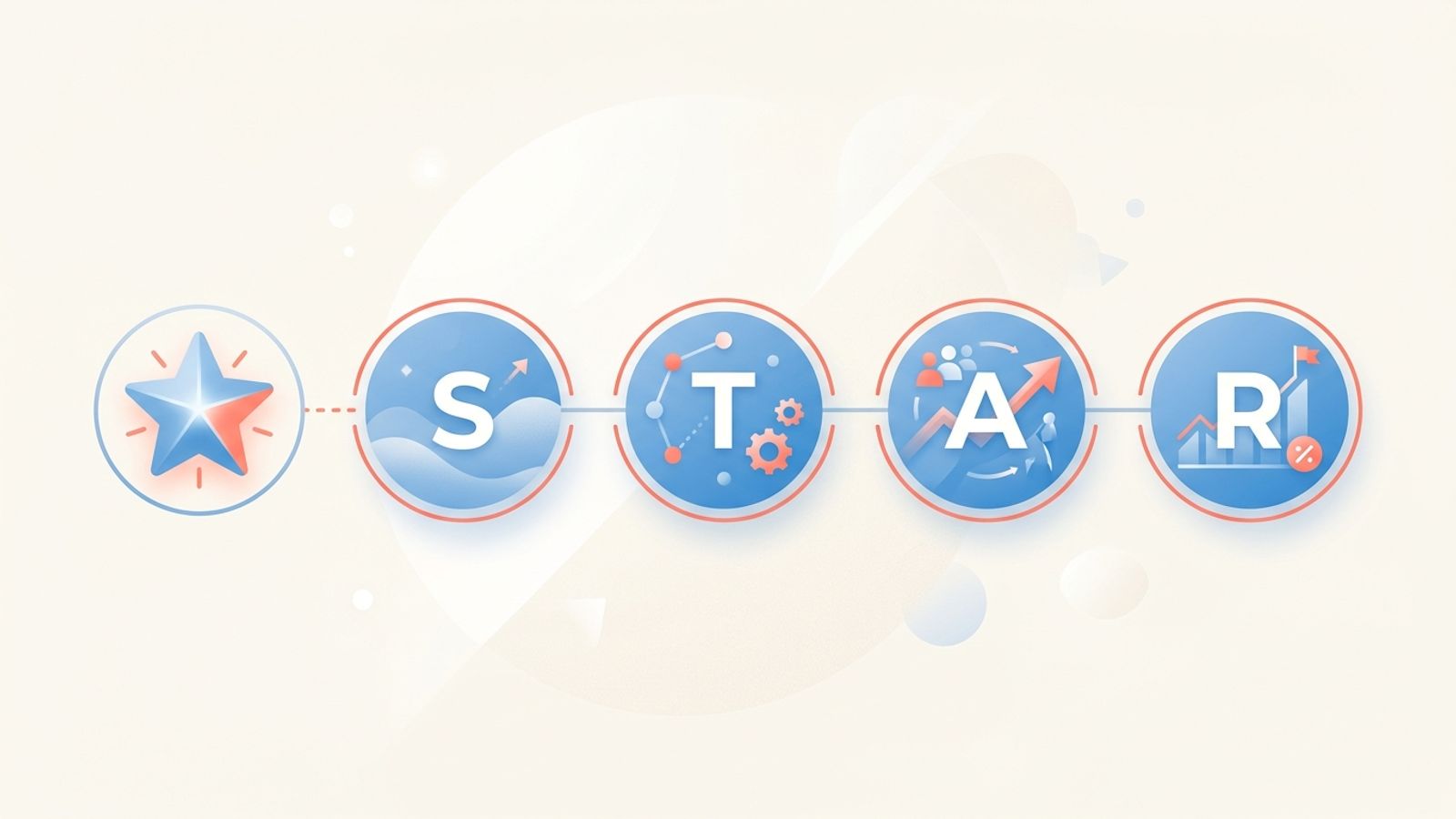
The STAR method is a way to answer behavioral interview questions. Situation, Task, Action, Result. Four parts, 60-90 seconds, structured enough to be clear, specific enough to be memorable.
It matters because interviewers rate structured answers significantly higher than unstructured ones. Research shows roughly one standard deviation difference in interviewer ratings between candidates who use a clear response format and those who ramble (Huffcutt & Arthur, 1994 meta-analysis). In practical terms: two candidates with the same experience, same qualifications. One tells a tight story. One meanders. The structured one gets the offer.
75% of Fortune 500 companies use behavioral interview questions (LinkedIn/SHRM data). If you're interviewing at any mid-to-large company, you'll face "tell me about a time when..." questions. The STAR method is how you answer them without losing the interviewer after 30 seconds.
Mirrai Careers
Match your resume to any job in seconds
Upload your resume, paste a job description, see your match score.
Try FreeFree month of Pro with code LAUNCH
What Is the STAR Method
STAR stands for Situation, Task, Action, Result. It's a format for answering behavioral interview questions using a specific past experience. The idea came from industrial-organizational psychology research in the 1980s-90s on structured interviewing, and it became the standard method after Schmidt and Hunter's 1998 meta-analysis demonstrated that structured interviews (r = 0.51 predictive validity) significantly outperform unstructured ones (r = 0.38).
The logic behind it: past behavior predicts future behavior better than hypothetical answers, self-assessments, or years of experience (which scores just r = 0.18 in the same meta-analysis). When an interviewer asks "tell me about a time you dealt with a difficult client," they don't want theory. They want a real event with a real outcome. STAR gives you a repeatable way to deliver that.
Every behavioral question maps to a STAR answer. "Tell me about a time when..." = Situation. "What were you responsible for?" = Task. "What did you do?" = Action. "What happened?" = Result. The question practically fills in the blanks for you.
STAR Method Breakdown: How Each Step Works
S: Situation (10-15 seconds)
Set the scene in two sentences. Company or context, the team, and the timeframe. The interviewer needs just enough detail to picture where this happened.
Good: "At my previous company, a B2B SaaS startup with about 200 customers, our biggest enterprise client threatened to cancel their $400K annual contract."
Bad: "So at this company, it was a tech company, we had a lot of clients, and there was this one client that was unhappy, and my boss was out that week so I had to handle it, and the thing was..."
The bad version burns 30 seconds on context the interviewer doesn't need. Two sentences. Move on.
T: Task (10-15 seconds)
What was your specific responsibility? Not the team's goal. Yours. This is where many candidates go vague. "The team needed to fix the problem" isn't a task. "I was responsible for the client relationship and had to resolve the issue before the contract renewal in 3 weeks" is a task.
If you were the lead, say it. If you were one contributor, say that. Claiming more ownership than you had will surface during follow-up questions and damage your credibility.
A: Action (30-45 seconds)
This is the longest section and the one that matters most. What did YOU personally do? Not your team. Not your manager. You.
Be specific about decisions and steps:
- "I set up a call with the client to understand their complaints" (specific)
- "I analyzed their usage data and found they were only using 30% of the features" (specific)
- "I built a custom onboarding plan and presented it to them within a week" (specific)
Contrast with what most people say: "We worked together to resolve it and made sure the client was happy." That tells the interviewer nothing about what you did. They're hiring you, not your team.
Watch for this: describing what you thought instead of what you did. "I realized the client was frustrated" is an observation. "I called the client that afternoon" is an action. Interviewers score actions, not epiphanies.
R: Result (15-20 seconds)
What happened? Use numbers whenever possible.
- "The client renewed for 2 years instead of 1, worth $800K" (revenue)
- "NPS score for that account went from 3 to 9" (satisfaction)
- "We reduced onboarding time from 6 weeks to 2 weeks" (efficiency)
- "The process I built was adopted by 3 other account managers" (scale)
If you don't have exact numbers, approximate. "We reduced churn by roughly 15%" is better than "things improved." If the outcome wasn't clearly positive, say what you learned. "The project was cancelled, but I applied the same approach to the next initiative and it worked." Failure stories are fine if they end with a real lesson and evidence you applied it.
Put together:
| Step | Time | What You're Saying |
|---|---|---|
| Situation | 10-15 sec | 2 sentences of context. Company, team, timeframe. |
| Task | 10-15 sec | Your specific role. What was on you. |
| Action | 30-45 sec | What you did. Decisions, steps, specifics. First person. |
| Result | 15-20 sec | Outcome with numbers. Or lesson learned if it failed. |
| Total | 60-90 sec | The whole answer. If you're over 2 min, you're rambling. |
STAR Method Examples
Six examples across the categories that come up most often. Use these as templates, not scripts. Swap in your own situations and numbers.
Example 1: Problem Solving
"Tell me about a time you solved a difficult problem."
STAR Answer
S: "At a fintech startup where I was a product analyst, our payment processing failure rate spiked from 2% to 8% over two weeks." T: "I was asked to diagnose the root cause and recommend a fix within 5 business days." A: "I pulled transaction logs for 3,000 failed payments and segmented them by payment method, geography, and time of day. I found that 70% of failures were on international cards processed between 2-6 AM UTC, which pointed to a timeout issue with our European payment provider. I coordinated with engineering to increase the timeout window and add a retry mechanism." R: "Failure rate dropped back to 2.1% within 3 days. The fix also prevented an estimated $180K in lost revenue per month."
Example 2: Teamwork
"Tell me about a time you worked with a difficult team member."
STAR Answer
S: "On a cross-functional product launch, one of the engineers consistently missed deadlines and wasn't communicating about blockers." T: "As the project lead, it was my responsibility to keep the launch on schedule." A: "I had a one-on-one with them and asked directly what was going on. It turned out they'd been pulled onto two other projects by their engineering manager without telling me. I escalated to both managers, got their priorities realigned, and restructured the sprint so their most critical tasks were front-loaded." R: "We launched one week late instead of the projected three weeks late. The engineer and I worked well together on the next two projects."
Example 3: Leadership
"Describe a time you led a team through a challenge."
STAR Answer
S: "I managed a customer success team of 6 when the company announced a 20% price increase with 30 days notice." T: "My team had to communicate the increase to 300+ accounts and manage the fallout while minimizing churn." A: "I created a tiered communication plan: top 20 accounts got personal calls from me, the next 80 got calls from the team with a prepared script and talking points, and the rest got personalized emails with a comparison table showing the value they'd received. I ran two practice sessions with the team before we started making calls." R: "We retained 94% of accounts. Only 18 cancelled, and 6 of those came back within 90 days when a competitor didn't deliver on their promises."
Example 4: Failure
"Tell me about a time you failed."
STAR Answer
S: "I was responsible for launching a referral program at a B2C subscription company." T: "Design the program, build the landing page, and hit 500 referrals in the first month." A: "I designed a double-sided incentive (give $10, get $10), built the page, and sent an email blast to our full user base on launch day. I didn't segment the audience or test the messaging beforehand." R: "We got 47 referrals. 91% below target. In the post-mortem, I identified that the email went to all users including those inactive for 6+ months who had no reason to refer anyone. I relaunched 3 weeks later targeting only active users with a personalized message and hit 620 referrals. The lesson was obvious in hindsight: test before you scale."
Example 5: Conflict
"Tell me about a disagreement with a colleague."
STAR Answer
S: "A sales director and I disagreed about feature prioritization. He wanted us to build a custom integration for one whale prospect worth $500K ARR." T: "As product manager, I needed to decide whether to allocate 6 weeks of engineering time to one client or continue work on the platform roadmap." A: "I built a quick analysis comparing the ROI: $500K from one client vs projected $1.2M from the 4 roadmap features based on pipeline data. I presented it to both of us and our VP in a 20-minute meeting with the numbers side by side." R: "We went with the roadmap. The sales director disagreed but respected the process. Three of those four features closed deals totaling $900K in the next quarter. The whale prospect signed anyway 6 months later when we had the capacity to build their integration."
Example 6: Time Management
"Tell me about a time you had to manage competing priorities."
STAR Answer
S: "In Q4, I was simultaneously managing a product launch, a site migration, and quarterly reporting. All three had hard deadlines within two weeks of each other." T: "I couldn't delegate all three. I needed to figure out which parts required me directly and which I could hand off." A: "I mapped every task across the three projects, tagged each as 'only I can do this' or 'someone else can do this with guidance,' and delegated about 40% of the work to two team members with clear briefs. I blocked my calendar for deep work mornings and reserved afternoons for check-ins." R: "All three shipped on time. The quarterly report was the strongest we'd published. One of the team members I'd delegated to told me it was the most ownership she'd had on a project, and she ran point on the next quarter's report solo."
STAR Method vs Other Interview Frameworks
STAR isn't the only format. Others exist. They all do roughly the same thing with different labels.
| Method | Stands For | How It Differs | When to Use |
|---|---|---|---|
| STAR | Situation, Task, Action, Result | The standard. Most recognized by interviewers. | Default for any behavioral question. |
| CAR | Challenge, Action, Result | Skips Task. More concise. | When the challenge IS the task. Saves 10 seconds. |
| PAR | Problem, Action, Result | Same as CAR with different naming. | Same situations. Personal preference. |
| SOAR | Situation, Obstacle, Action, Result | Adds obstacle/difficulty emphasis. | Failure and challenge questions specifically. |
Use STAR. Interviewers trained in structured interviewing are scoring you on Situation, Task, Action, Result specifically. The other methods are fine but you gain nothing by using them and you risk missing a scoring category. Stick with the standard.
Common STAR Method Mistakes
Knowing the acronym is easy. These are the ways people get the letters right and still blow the answer.
Too much Situation, not enough Action. Most people spend 40% of their answer setting the scene and 20% on what they did. Flip it. The Action section is where the interviewer evaluates your judgment, initiative, and skills. Two sentences of context is enough. Get to what you did.
Saying "we" instead of "I." Teamwork is great. But the interviewer is hiring you, not your team. If you led the effort, say "I." If you contributed to a group effort, say "I" for your part and "the team" for the rest. "We fixed the problem" is uninformative. "I identified the root cause and the team implemented the fix across 3 systems" is clear.
No numbers in the Result. "Things improved" is not a result. "Revenue increased 22%" is. "The client was happy" is not a result. "The client renewed for 2 years and referred us to 3 other companies" is. If you don't have exact numbers, estimate. "Approximately" or "roughly" in front of a number is better than no number at all.
Picking ancient stories. A STAR answer from 2015 makes the interviewer wonder what you've been doing for the last decade. Stick to the last 2-3 years. If your best example is older, flag it briefly: "This was a few years back, but it's the clearest example of this skill."
Choosing a situation where you weren't the driver. Some candidates describe a project where they were a minor contributor and try to claim credit for the outcome. Follow-up questions will expose this fast. Pick stories where your actions directly caused the result. If you can't draw a clear line from what you did to what happened, pick a different story.
How to Prepare STAR Stories
You don't need 25 stories. You need 6-8 good ones that cover the main categories. One story can answer multiple questions depending on which part you emphasize.
| Category | Prepare This Many | Questions It Covers |
|---|---|---|
| Problem Solving | 2 stories | "Solved a hard problem," "used data to make a decision," "identified a risk" |
| Teamwork | 2 stories | "Worked with difficult people," "collaborated cross-functionally," "gave feedback" |
| Leadership | 1-2 stories | "Led a project," "motivated others," "made a tough call" |
| Failure / Conflict | 1-2 stories | "Failed at something," "received criticism," "disagreed with someone" |
| Time Management | 1 story | "Managed priorities," "handled pressure," "missed a deadline" |
Write each story in STAR format. Practice saying them out loud. Time yourself. Cut anything that pushes you past 90 seconds. Then forget the exact words and remember the beats: situation (2 sentences), task (1 sentence), action (3-4 sentences), result (1-2 sentences with a number).
Full list of the most common behavioral questions with sample answers: behavioral interview questions guide.
Before you leave
See how your resume stacks up
Paste any job description and get your match score in 30 seconds.
Try FreeFree month of Pro with code LAUNCH
FAQ
Do I have to use the STAR method for every interview answer?
What if my result wasn't clearly positive?
Should I mention other people's contributions?
How do I know if I'm using STAR correctly?
Is STAR outdated? Are there better methods?
Build your interview story bank by understanding your actual strengths first. Mirrai's career assessment identifies your top skills so you know which stories to prepare.