Mirrai Careers
"What Are Your Strengths and Weaknesses?" How to Answer (2026)
66% of hiring managers detect fake weakness answers. 95% of people think they're self-aware but only 10-15% are. How to answer honestly without sabotaging yourself.

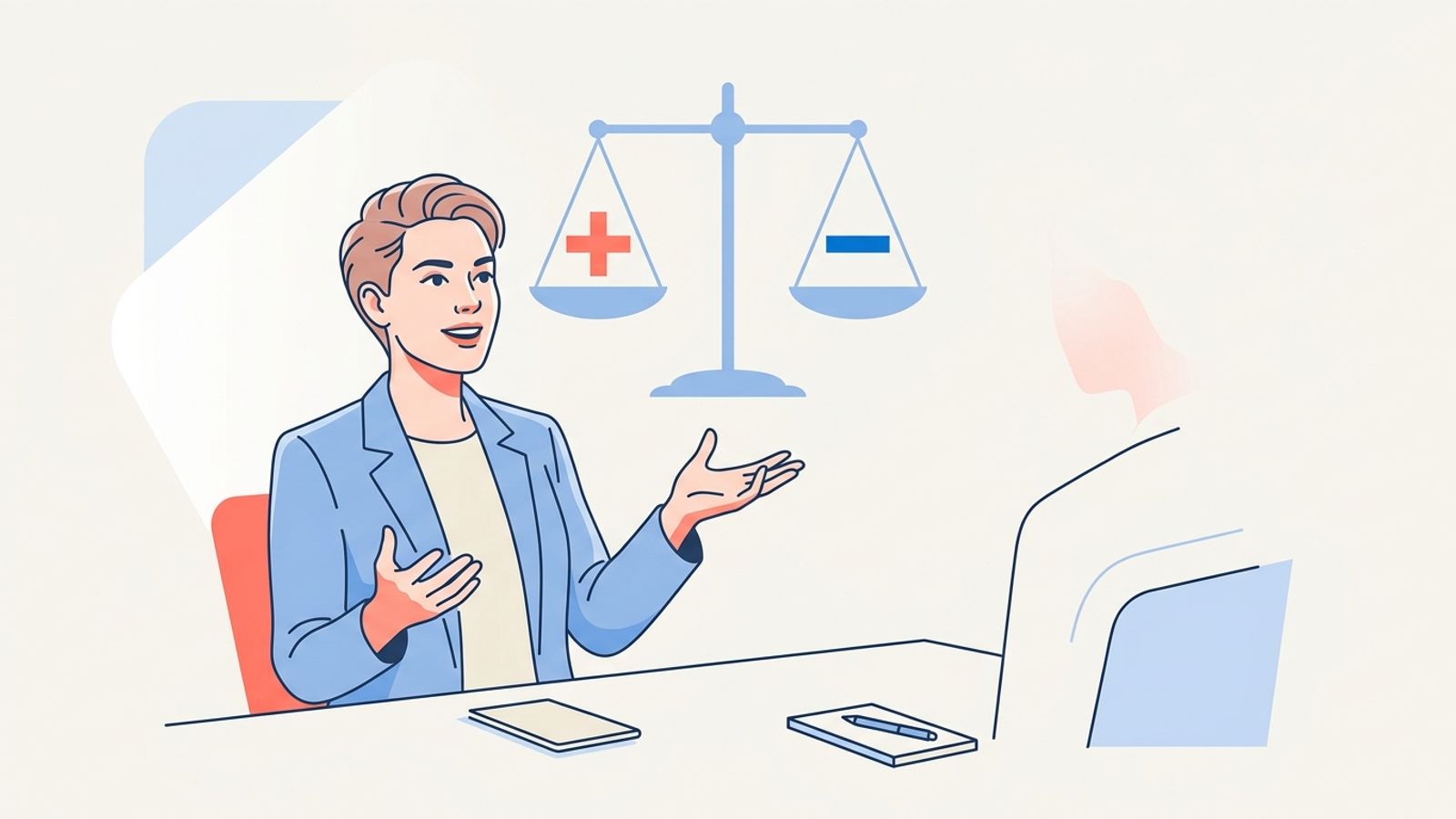
"What is your greatest weakness?" shows up in roughly 50-70% of job interviews (LinkedIn/Glassdoor data). It's been around for decades and everybody hates it. Candidates hate it because it feels like a trap. Interviewers hate it because 90% of answers are the same rehearsed garbage.
"I'm a perfectionist." "I work too hard." "I care too much." 66% of hiring managers say they can tell when a candidate is giving a rehearsed or inauthentic answer (CareerBuilder, 2018). Those three responses are the top eye-rollers. If you've been planning to use one of them, don't.
The question is actually testing something specific, and once you understand what that is, the answer gets much easier.
Mirrai Careers
Match your resume to any job in seconds
Upload your resume, paste a job description, see your match score.
Try FreeFree month of Pro with code LAUNCH
What the Interviewer Is Really Evaluating
They're not trying to find a reason to reject you. They're testing self-awareness.
Organizational psychologist Tasha Eurich found that 95% of people believe they're self-aware, but only 10-15% actually are (Eurich, 2018, "Insight"). Interviewers ask this question to find out which group you're in. A candidate who can name a real weakness and explain what they're doing about it is rare. That rarity is the point.
A Korn Ferry/Green Peak Partners study on executive hiring found that self-awareness was the single strongest predictor of leadership success, outperforming experience, education, and technical skills. This isn't just a feel-good insight. Leaders with high self-awareness produced better financial results.
75% of hiring managers rank honesty and authenticity above technical competence in initial screening rounds (TopInterview survey). Candidates who acknowledged a real weakness and described how they're addressing it were 3x more likely to advance than those who gave a polished non-answer.
So when they ask "what's your weakness," they're checking: can this person be honest about their own gaps? Because people who can't do that are nearly impossible to manage, train, or give feedback to.
How to Answer "What Are Your Strengths?"
This one trips people up less, but most answers are still too vague. "I'm a strong communicator" means nothing without proof. The formula:
[Specific strength] + [Context where you used it] + [Result with a number]
Examples that work:
Example: Data Analysis
"My strongest skill is translating data into decisions. At my last company, I built a dashboard that tracked customer churn signals across 50,000 accounts. The sales team used it to prioritize outreach, and we reduced churn by 18% in one quarter."
Example: Project Management
"I'm good at keeping complex projects on track when there are a lot of moving parts. I managed the migration of our CRM to a new platform across three departments and 200 users. We finished two weeks ahead of schedule with zero data loss."
Example: Stakeholder Communication
"I'm strong at getting alignment between teams that don't naturally talk to each other. In my last role, engineering and sales were constantly clashing over feature priorities. I set up a monthly roadmap review where both sides could see the tradeoffs. Feature escalations dropped by about 60%."
All three share one thing: a specific skill backed by a specific situation with a measurable outcome. "I'm a hard worker" has none of that. Anyone can claim it. Nobody remembers it.
Not sure what your actual strengths are? A career assessment gives you data on where you rank across different skill areas. Better than guessing.
How to Answer "What Are Your Weaknesses?"
This is where people panic and say something stupid. The instinct is to either humble-brag or confess something career-ending. Neither works. Aim for the middle: real enough to be believable, manageable enough that it won't scare them off. The formula:
[Real weakness that won't disqualify you] + [Specific example of it causing a problem] + [What you're doing to fix it]
The Fake Weakness Trap
Avoid these:
- "I'm a perfectionist." Everyone says this. It's a humblebrag. The interviewer has heard it 500 times.
- "I work too hard." You're not fooling anyone. This is a compliment dressed as a confession.
- "I care too much about quality." Same energy. The interviewer nods politely and writes "not self-aware" in their notes.
A real weakness is something you've actually struggled with that's relevant to work. Not a character flaw. Not a felony. Just a professional gap you're honest about.
Examples That Actually Work
Example: Public Speaking
"I get nervous presenting to large groups. In my first year as a team lead, I had to present quarterly results to the executive team and I rushed through my slides because of nerves. I've been working on it since then. I joined an internal presentation club and now I volunteer for team demos. I'm not completely comfortable yet, but I'm a lot better than I was two years ago."
Example: Delegation
"I tend to take on too much myself instead of delegating. Last year I was managing three projects and trying to do the analysis work myself instead of handing it to my team. My manager flagged it. Since then, I've started using a simple rule: before taking on a task, I ask myself whether I'm the only person who can do this task. If the answer is no, I assign it. I'm still catching myself sometimes, but the default has shifted."
Example: Detail Orientation
"I sometimes miss small details when I'm moving fast between tasks. In one project, I sent a client report with an error in one of the tables because I'd rushed the final review. Now I block 30 minutes before any deliverable goes out for a dedicated review pass. My error rate has gone down significantly since I made that a habit."
Example: Saying No
"I have a hard time saying no to requests, which means I sometimes overcommit. I realized this was a problem when I had to work weekends three months in a row because I'd agreed to too many side projects. Now I use a simple rule: before saying yes, I check my current workload and ask whether the new request is higher priority than something I'm already doing. If it's not, I say not right now."
Same pattern every time: a real gap, a real consequence, and a real change you made. The interviewer doesn't expect perfection. They expect you to be the kind of person who notices their own problems and does something about them. That's a surprisingly rare quality.
Strengths and Weaknesses Examples by Role
Quick reference for common roles. Adapt these to your actual experience.
| Role | Strength Example | Weakness Example |
|---|---|---|
| Software Engineer | Debugging complex systems under pressure | Estimating task timelines accurately |
| Marketing Manager | Data-driven campaign optimization | Saying no to stakeholder requests |
| Project Manager | Keeping cross-functional teams aligned | Getting too deep in execution vs strategy |
| Sales | Building long-term client relationships | Detailed CRM documentation |
| Designer | User empathy and research synthesis | Presenting rationale to non-designers |
| Data Analyst | Finding patterns in messy datasets | Communicating findings to non-technical audiences |
| Teacher / Trainer | Adapting content to different learning styles | Setting boundaries on availability |
The key is picking a weakness that's real but not fatal for the role. If you're applying for a detail-oriented position, "I miss details" is the wrong choice. If you're applying for a leadership role, "I struggle with delegation" works because you're acknowledging a growth area that matters for the job.
Before you leave
See how your resume stacks up
Paste any job description and get your match score in 30 seconds.
Try FreeFree month of Pro with code LAUNCH
FAQ
Can I say "I don't have any weaknesses"?
Should my weakness be related to the job?
How many strengths and weaknesses should I prepare?
What if my real weakness is something I can't fix?
Know your actual strengths before the interview. Take the career assessment for a data-backed breakdown of where you stand. Beats making it up on the spot.