Mirrai Careers
Resume Buzzwords: Which to Cut and What to Write Instead
"Team player." "Detail-oriented." "Results-driven." Recruiters have read these 10,000 times. Here's what to write instead.

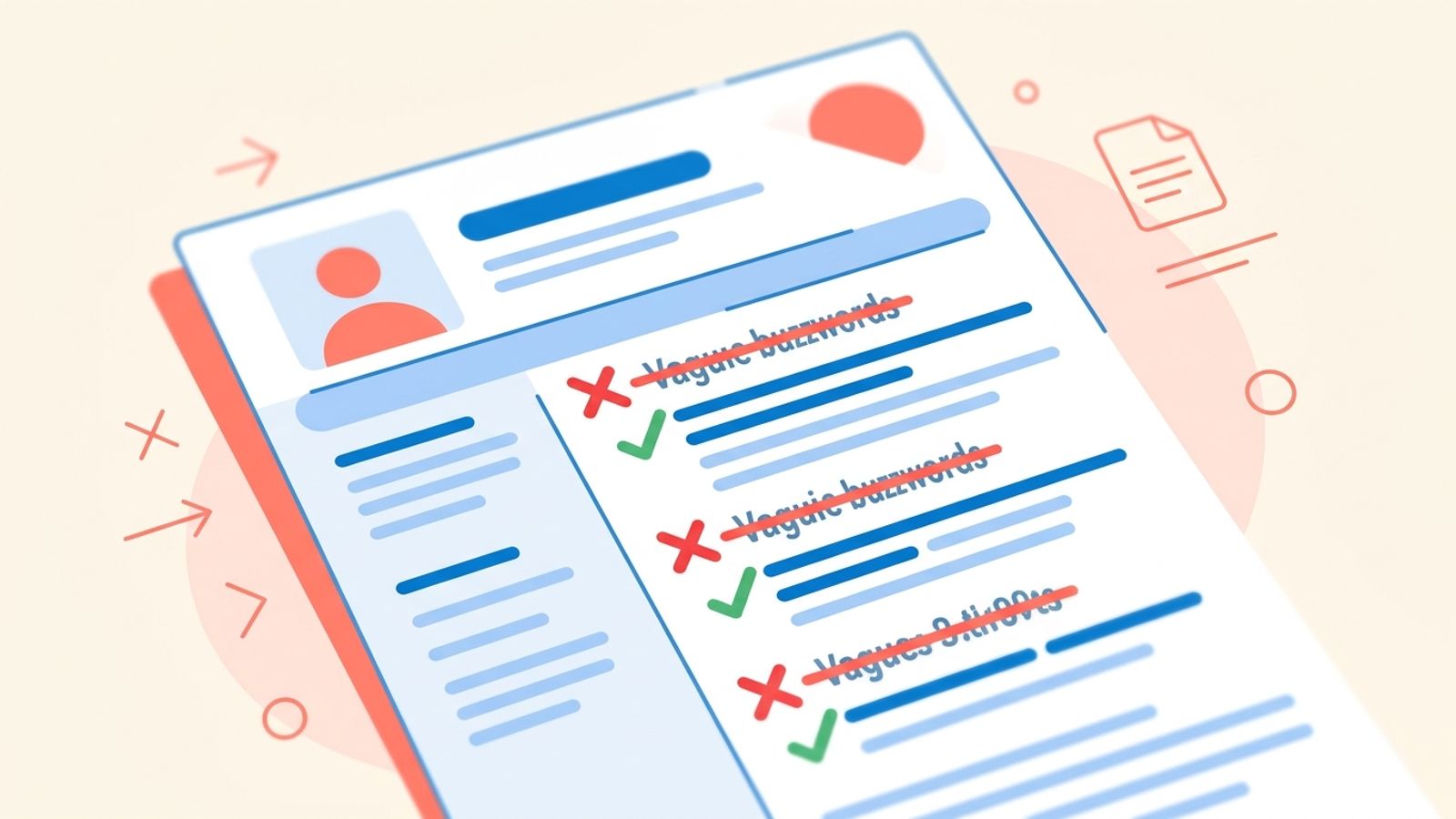
"Results-driven professional with a proven track record of leveraging synergies to drive strategic initiatives in fast-paced environments."
That sentence says absolutely nothing. It contains seven buzzwords and zero information. A recruiter reading it learns nothing about who you are, what you've done, or why they should care. And some version of it appears on millions of resumes.
The problem with buzzwords isn't that they're wrong. "Team player" might be true. "Detail-oriented" might be accurate. The problem is that everyone writes them, so they carry no signal. When every candidate describes themselves as a "motivated self-starter," the phrase stops meaning anything.
“A resume with zero context will sound generic, a lot like a job advertisement. Without metrics everything seems kinda blah.”
Mirrai Careers
Match your resume to any job in seconds
Upload your resume, paste a job description, see your match score.
Try FreeFree month of Pro with code LAUNCH
Resume Buzzwords to Stop Using
These show up constantly and tell the recruiter nothing they can evaluate. Cut them or replace them with proof.
| Buzzword | Why It Doesn't Work | Write This Instead |
|---|---|---|
| Team player | Everyone says it. Nobody can disprove it. | "Collaborated with 4 departments to ship a product used by 10K users" |
| Detail-oriented | Self-reported. Can't be verified from a resume. | "Reduced reporting errors by 35% by building a QA checklist for monthly deliverables" |
| Results-driven | Vague. What results? Driven how? | "Grew enterprise pipeline 40% in 12 months through targeted outbound campaigns" |
| Hard-working | Every candidate claims this. It's table stakes. | "Managed 3 concurrent product launches across 2 time zones" |
| Self-starter | Usually means "we won't train you." But on a resume, it's filler. | "Identified and built an internal analytics dashboard that became the team's primary reporting tool" |
| Proven track record | Proven by what? Track record of what? | "Exceeded quarterly targets 8 of the last 10 quarters" |
| Passionate | About what? How does passion show up in your work? | "Volunteered to lead the company's first sustainability audit, saving $120K annually" |
| Synergy / Leverage | Corporate jargon. Nobody talks like this in real life. | "Connected sales and product teams through weekly alignment meetings, reducing feature request turnaround by 50%" |
| Go-getter | Sounds like a LinkedIn motivational poster. | "Proposed and launched a customer referral program that brought in 200 new accounts in Q1" |
| Dynamic | Means nothing without context. | "Adapted the marketing strategy mid-quarter after a competitor launch, recovering 90% of projected pipeline" |
Every replacement in that table does the same thing: swaps a claim for evidence. That's the only trick. Stop telling recruiters what kind of person you are. Show them what you've done.
When Buzzwords Are Actually Fine
Not all buzzwords are bad. Some are keywords that ATS systems actively scan for.
"Project management" is a buzzword. It's also a keyword that the ATS is looking for when the JD says "project management experience required." "Agile" is jargon. It's also a required skill in half of tech job descriptions.
The rule: if the exact phrase appears in the job description, include it on your resume. That's not buzzword stuffing, that's keyword matching. The ATS is literal. If the JD says "cross-functional collaboration," use that phrase.
For a full walkthrough on matching your resume to the JD: how to tailor your resume to a job description.
How to Replace Buzzwords With Real Content
For every vague claim on your resume, ask yourself: "Can I attach a number or a specific example to this?" If yes, rewrite it. If no, cut it.
The Conversion Formula
[Buzzword claim] becomes [Action verb] + [What you did] + [Measurable result]
Before: "Skilled communicator with strong presentation abilities"
After: "Presented quarterly results to the executive team (20+ people) for 3 consecutive years, leading to approval of a $2M budget increase"
Before: "Innovative problem solver"
After: "Redesigned the customer onboarding flow after identifying a 40% drop-off in step 3, increasing completion rate from 55% to 82%"
The first versions are opinions about yourself. The second versions are evidence. Recruiters trust evidence.
What If You Don't Have Numbers?
Estimate. "Managed roughly 15 client accounts" is better than "managed client relationships." "Trained approximately 30 new hires" is better than "trained new employees." Approximations are honest and specific. Buzzwords are neither.
If you genuinely can't quantify something, describe the scope: how many people, how much budget, what timeframe, which teams. Scope is the next best thing to a number.
For help with strong action verbs: action words for resume.
The Skills Section Buzzword Trap
Skills sections are where buzzwords hide most. "Leadership." "Communication." "Problem solving." "Time management." These are so generic they add nothing.
Your skills section should contain things that are testable and verifiable:
- Technical tools: "Python, SQL, Tableau, Salesforce, HubSpot"
- Certifications: "PMP, AWS Solutions Architect, Google Analytics"
- Concrete skills: "Financial modeling, A/B testing, regulatory compliance, contract negotiation"
"Communication" and "leadership" belong in your bullet points where you can prove them with a story. Listing them as skills is like writing "good at driving" on a race car application. Show the lap time instead.
Full guide on what to include: skills to put on a resume.
Before you leave
See how your resume stacks up
Paste any job description and get your match score in 30 seconds.
Try FreeFree month of Pro with code LAUNCH
FAQ
Are all buzzwords bad?
What about "motivated" in a resume summary?
Can I use buzzwords in a cover letter?
How do I know if a word on my resume is a buzzword?
Replace buzzwords with matched keywords. Mirrai's Job Matcher analyzes the job description and shows you exactly which terms your resume needs. Real keywords, not fluff.