Mirrai Careers
What Is an ATS? How Applicant Tracking Systems Work (2026)
97.8% of Fortune 500 companies use an ATS. It is not a robot that rejects your resume. It is a database that makes you findable or invisible. Here is how it works.

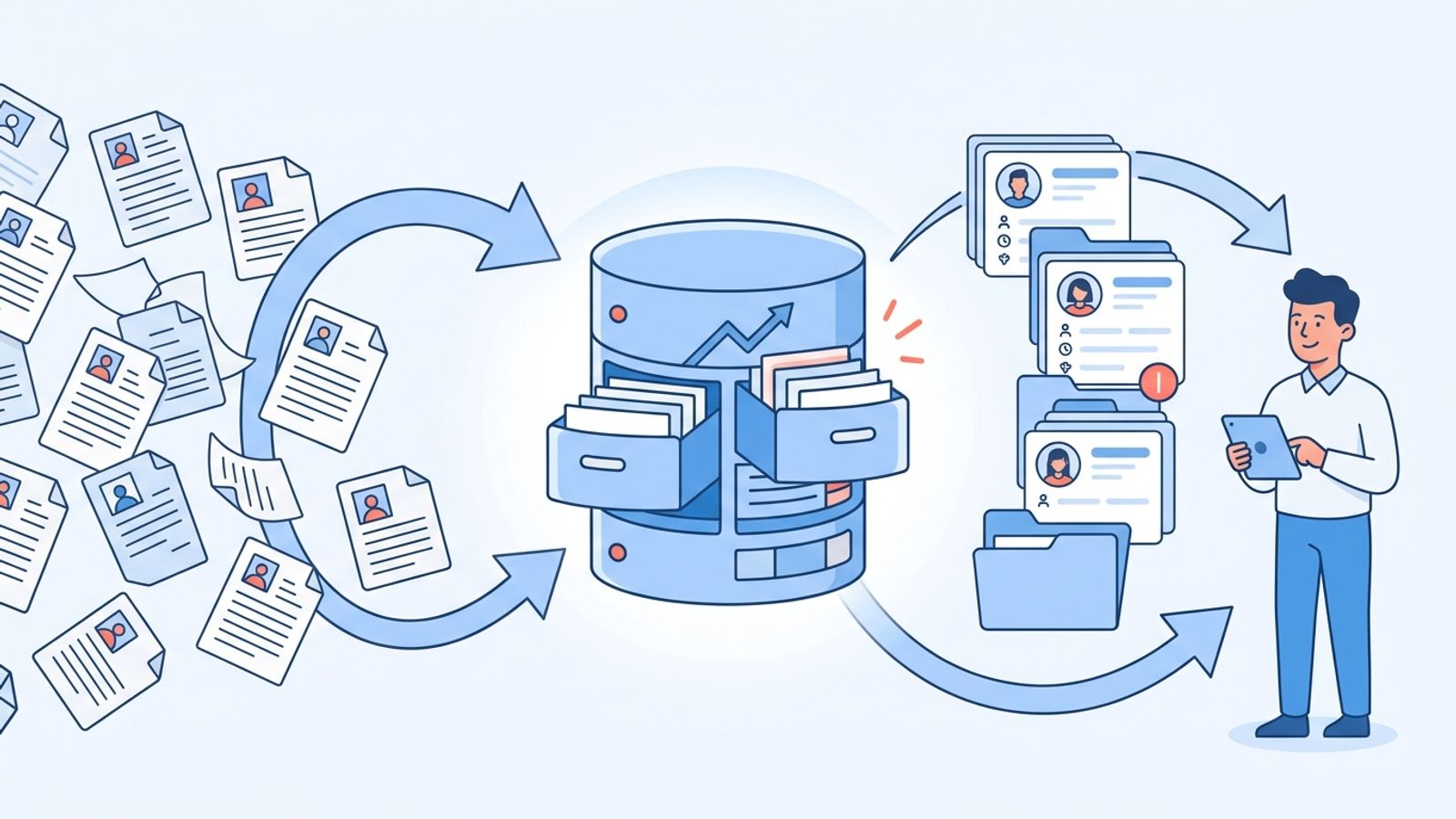
An ATS (Applicant Tracking System) is software that companies use to manage hiring. It collects applications, stores resumes in a searchable database, screens candidates by keywords, schedules interviews, and tracks every step from "job posted" to "offer accepted." Before ATS existed, the closest thing was a filing cabinet, a phone, and a spreadsheet.
Nobody invented ATS to torture job seekers. They invented it because 250 applications per posting would drown any human. The torture is a side effect, not the purpose.
97.8% of Fortune 500 companies use one. About 70% of large companies (1,000+ employees) and 20-35% of small businesses do too. The global ATS market is worth $3-17 billion depending on who counts (different research firms, different methodologies) and growing at 7-12% annually.
If you have applied for a job at any mid-to-large company in the past decade, your resume went through an ATS. Whether anyone saw it after that depends on how well it matched what the recruiter was searching for.
Mirrai Careers
Match your resume to any job in seconds
Upload your resume, paste a job description, see your match score.
Try FreeFree month of Pro with code LAUNCH
Why Companies Use ATS
Three reasons, all related to volume:
| Problem | How ATS Solves It | Data |
|---|---|---|
| Too many applicants | Organizes and ranks candidates by relevance | Average job posting: 250+ applications. Only 4-6 get interviewed. Interview rate: 3% in 2024, down from 15.3% in 2016 |
| Legal compliance | Automates EEOC tracking, OFCCP reporting, GDPR consent | Federal contractors must retain applicant records for 2+ years. Non-compliance risks: fines, lost contracts |
| Cost and speed | Reduces manual screening by 60%+ | 86% of ATS users say it reduced time-to-hire. Cost-per-hire drops up to 30%. Small businesses save up to $10K/year |
The adoption story is boring: processing 250 applications by hand, while keeping legal records on every single one, would require hiring three people just to manage hiring one. Companies chose software. You'd have done the same.
A Brief History of ATS
| Era | What Happened |
|---|---|
| 1970s-1980s | First digital tools for storing candidate info. Mainly for compliance — reducing lawsuits through consistent processes |
| 1990s | Purpose-built ATS software appears alongside the internet. Monster.com and CareerBuilder launch. Resumes go digital. |
| 1999 | Recruitsoft (later renamed Taleo) launches web-based hiring management |
| 2005 | Taleo becomes the enterprise standard |
| 2010s | Cloud ATS arrives. SaaS pricing makes it affordable for smaller companies. Greenhouse, Lever emerge. |
| 2012 | Oracle acquires Taleo for $1.9 billion. ATS is now enterprise-critical infrastructure. |
| 2020 | Google sunsets its own ATS product "Hire." Even Google could not crack this market. |
| 2025-2026 | 79% of organizations integrate AI into their ATS. Skills-based hiring replaces keyword-only matching. |
What ATS Does With Your Resume
When you click "Submit," your resume hits a pipeline: upload, parse, match, rank, then maybe a human looks at it.
- ATS converts your document into structured data: name, email, job titles, skills, dates, education
- It checks those fields against the job description to score relevance
- Recruiters search the database using keyword filters (76% filter by skills, 55% by job titles)
- Your resume either shows up in their search results or it does not
- A recruiter opens the top results and spends 7.4 seconds deciding whether to keep reading
ATS stores your original file alongside the parsed data. If parsing failed, a recruiter who specifically opens your file can still read it. The problem: they have to find you first, and the search runs on parsed data.
For the full technical breakdown with parsing accuracy data by format and system-specific rules, see our ATS Resume Guide.
The Biggest ATS Systems
| System | Used By | Notable |
|---|---|---|
| Workday | 39% of Fortune 500 | Dominant in large enterprises. Strictest parser of the major systems. |
| SAP SuccessFactors | 13% of Fortune 500 | Strong in European and global companies |
| Taleo (Oracle) | 10% of Fortune 500 | Bank of America, FedEx. Oldest major ATS still in use. Declining but entrenched. |
| iCIMS | 40% of Fortune 100 | Amazon (fulfillment, AWS, Whole Foods), Target, CVS Health. Largest overall market share (11%). |
| Greenhouse | Tech-forward companies | Netflix, Airbnb, HubSpot, Reddit. No auto-scoring — humans evaluate. |
| Lever | Growth-stage companies | Most formatting-tolerant. Holistic candidate profiles. |
200+ ATS vendors compete in the market. The system your resume lands in depends on the company, not on you. A resume that parses perfectly in Greenhouse may struggle in Taleo, and vice versa. The safest approach: single-column layout, standard fonts, .docx format. Works everywhere.
What This Means for Job Seekers
ATS is not your enemy. It's plumbing. But knowing how the plumbing works changes everything about how you apply:
- Your resume is in a database. Recruiters find you by searching keywords. If your resume uses different words than the job description, you are invisible to their search.
- Formatting matters because it affects parsing, not because ATS "rejects" bad formatting. 92% of recruiters say their ATS does not auto-reject (Enhancv 2025).
- Knockout questions on the application form are the only common automatic filter. Answer them honestly and carefully.
- Tailoring each resume to the job description matters more than any template or format trick. Tailored resumes get 3x the callback rate of generic ones.
- Referrals bypass ATS entirely. 7% of the candidate pool, 40% of hires (Zippia).
27 million Americans are systematically screened out of jobs they qualify for due to arbitrary ATS filters: employment gaps, degree requirements, age patterns (Harvard Business School / Accenture "Hidden Workers" study). 88% of employers in that study acknowledged their ATS weeds out qualified candidates. The system has real problems. You can't fix them from outside. Work within it while it exists, and if you ever end up on the hiring side, remember what it felt like on this side.
ATS vs AI Hiring Tools
| Traditional ATS | AI Screening (added layer) | |
|---|---|---|
| What it does | Stores, organizes, tracks applications | Scores, matches, predicts candidate fit |
| How it screens | Keyword matching, Boolean filters | Contextual understanding, skill inference |
| Synonym handling | 66% cannot understand synonyms | Reads context, connects related skills |
| Who decides | Humans search and filter | AI recommends, humans decide |
| Trust level | Standard business tool | Only 26% of candidates trust AI to evaluate them fairly |
The line between ATS and AI hiring tools is blurring fast. 79% of organizations have integrated AI into their ATS in some form. Modern platforms like iCIMS and SmartRecruiters use AI to auto-extract skills from your full resume text (not just the skills section) and to surface candidates that traditional keyword matching would miss.
But no recruiter trusts the AI fully. Recruiter Jared Harris (Sutter Health): "We are not really trusting it. It is hit and miss." Recruiter Csudi Csudutov (20+ years): "No recruiter I know would trust an ATS with filtering. They don't want to risk losing otherwise perfectly good candidates."
The Candidate Experience Problem
The system has a cost for the people going through it:
- 61% of job seekers report being ghosted after an interview (up 9 points from 2024)
- 92% never complete applications they start, due to length and complexity
- 72% report negative mental health impacts from long hiring processes
- 43% of job listings may be "ghost jobs" — posted but never intended to be filled
- Average wasted time per ghosted application: 47 hours
78% of candidates say how a company treats them during hiring reflects how it will treat them as an employee. The irony: companies adopted ATS to be more efficient, but the efficiency often comes at the cost of candidate experience. That gap is a real problem the industry is slowly starting to address.
Some of that waste is on the candidate to dodge. The same ATS platforms above (Greenhouse, Lever, Ashby) post openings on company career pages, and a search that reads those pages directly catches roles the day they go live and flags the ones that have been sitting open for months. Mirrai's AI Job Search works this way, ranking openings against your resume and burying the likely ghosts, so fewer of your applications disappear into a posting nobody was ever going to fill.
“After three rounds, they sent me an auto-rejection. No name, just 'Dear Applicant.'”
Check how your resume performs against any job description. See your ATS match score in 30 seconds.
Before you leave
See how your resume stacks up
Paste any job description and get your match score in 30 seconds.
Try FreeFree month of Pro with code LAUNCH
FAQ
Does ATS automatically reject my resume?
Do small companies use ATS?
Can I see my ATS profile?
How long does my resume stay in ATS?
Is ATS going away?
How do I avoid wasting time on ghost jobs?
Build a resume that works with any ATS. Try Mirrai's free Resume Builder. It handles formatting, keywords, and job description matching automatically.